Related Posts with Thumbnails
Become a Subscriber

Receive YourLifeIsATrip by Email

Enter your email address:

Preview | Powered by FeedBlitz

Bookmark and Share

Subscribe via RSS feed

Support This Site
Catch up with us on:
Visit our corporate sponsors


Luxury Hotels The Kiwi Collection

Prague accommodation

Access to over 600 airport lounges worldwide with Priority Pass

Panama Hotels - Veneto Panama

Traveling to a particular country? Make the most of your trip with Lonely Planet Country Guides.

Priceline.com Airfare - Choose your EXACT flight & time!

Save up to 25% on Last Minute Adventure Travel Packages Gap Adventures

Travel Insurance: Simple & Flexible WorldNomads.com

ReboundTag.com: Microchip your possession. 

Read More By Our Contributors

Googe Ads


You can always extend your policy while you are away.


Visit Our Partner Site
YourLifeIsATrip.com Gains Attention!

YAY!

We're thrilled and honored to be a recommended travel blog at www.TravelBlogs.com.


Navigation
Powered by Squarespace
« No, I Don't Speak Spanish | Main | China's Wild Wall »
Monday
Feb222010

Blood On His Hands

words and photos by Elyn Aviva


He was a good-looking guy, even though he had blood on his hands and his jacket was spattered with red stains. His eyes were intense, his smile tight, his long fingers graceful as he sharpened his knife, the thin blade scraping rhythmically against the long steel rod.
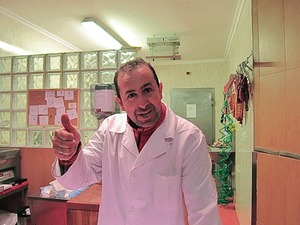
The carnicería was packed with customers, patiently impatient, enjoying Julio’s ongoing spiel, willing to wait (for wait we would) while he cut each piece of meat to order. There were five butcher shops (not counting two supermarkets) in Sahagún, the small town in northern Spain where we were living, but this was the best. I had it on good authority.

“He’s an artist,” my late friend Paca had explained. “He can slice a piece of meat so thin you can see Barcelona through it.” No small task, given that Barcelona is 500 miles to the east.

Inside the entrance to the small shop was a red ticket machine. Take a number and you will know where you stand. Or so I thought at first. But I was quickly disabused. The flashing number on the bright-lit sign above Julio’s head never changed.

“Who’s last in line?” I asked, my limited Spanish having expanded to cover such necessities. A man leaning on a cane pointed to the elderly, burgundy-haired woman beside him; she nodded. I knew my place and sat down to wait. And wait. An hour would be fast, I realized, for it was just before the holidays, and everyone was stocking up to feed the hoards of friends and relatives returning home.

Homemade chorizo sausage, marinated pork loin, pork tongues, skinned rabbits, quarters of young and slightly older lamb, whole chickens, duck pâte, smoked pork chops, soup bones, bacon, tiny quails packed close together, pig ears, beef steaks, stew meat, chunks of beef to slice into fillets—and more—were tightly packed inside the glass-fronted case that separated Julio from his customers. Another case was crammed with rounds of cheeses and heaps of packaged pork products, its flat top covered with jars of leeks and asparagus and tuna, and bottles of local fruit conserves. On the wall behind, assorted Iberian hams hung from ropes tied around their shanks.

Time passed. Voices rose. Julio was in animated conversation with the elderly burgundy-haired señora. He waved his glistening knife for emphasis, then disappeared into the walk-in freezer and soon returned, hauling a haunch of beef. He dumped it on a wooden table worn down in the center from years of use.

Frowning intently, he carefully slipped his knife into the flesh, separating meat from bone. He tossed a hunk onto the scale, then slid it onto butcher’s wrap, folding and twisting the paper into a tidy package. It joined others in a plastic bag. With a flourish, he summed up the woman’s purchases on the scale, a machine that functioned both to weigh and keep a running tally.

“Who’s next?” He asked. People began to murmur and look around.

I raised my hand and stepped up to the glass display case. The crowd parted, but not much, since the ladies were curious what I would buy.

“What do you want today? Beef steak? Lamb?” He pointed at a slab of bones and meat. “This is delicious. Exquisite. Don’t miss it.”

I nodded, trusting that Julio wouldn’t steer me wrong. His knew his meat—and his customers. He really knew his meat. Once I had asked him if the lamb was organic. Offended, he replied, “It’s better than that—it’s natural!” and went on to explain that that particular lamb had grazed in the fields 30 miles to the north of our small town. He knew its owners, what it had been fed—I think he knew its pedigree, but I wasn’t interested. I want to eat it, not trace its family tree. The beef came from another nearby farm, where it had ranged in open pastures until Julio had chosen it to take to the slaughter house. He really knew his meat.

“Ground beef,” I requested.

“How much?”

“A pound or two.”

He nodded, looked thoughtful for a moment, then chose a chunk of beef. “Beef only or do you want to add some pork?”

“Whatever you think best.”

The woman next to me said, “It’s better with some pork. More flavor.”

“She’s right,” said Julio.

“You know what’s best,” I replied, watching him place the pieces in the grinder.

“Anything else?”

I pointed at a quarter of young lamb, complete with ribs and leg. He nodded in approval. “To roast?”

“I’d like to, but I don’t know how.”

His face lit up and he began to explain, relishing the details. A woman disagreed with his instructions, insisting that a little olive oil was necessary. An argument ensued and members of the crowd joined in. Julio grinned and cut a slab of pork fat to drape on top of the meat, then added a few handfuls of his homemade mix of parsley, salt, and garlic.

“You’ll see,” he said, bringing his bloody fingers to his lips as if to kiss them. “It will be the most delicious lamb you’ve ever tasted.”

I thought a moment, wondering if I needed anything else.

“Leave some for us!” another elderly, burgundy-haired woman said with a smile. (Burgundy is the dye color of choice for older women in this part of Spain.)

I smiled back, paid a miniscule amount for so much meat, gathered up my plastic bags, and started out the door. I heard a rhythmic sound and glanced back. Julio was sharpening his knife again.

View Photos 

Elyn Aviva is a writer, fiber artist, and transformational traveler. Currently living in Sahagún (León), Spain, she is fascinated by pilgrimage and sacred sites. Her PhD in anthropology was on the modern Camino de Santiago in Spain. Aviva is co-author of Powerful Places on the Caminos de Santiago, Powerful Places in Scotland, and other books on pilgrimage and journey. To learn more, go to www.pilgrimsprocess.com and www.fiberalchemy.com

Related Posts with Thumbnails

PrintView Printer Friendly Version

EmailEmail Article to Friend

Reader Comments (25)

Fun to read... though since I've become a vegetarian (except for wildcaught fish), it's kind of hard for me to relate.... Hope the standards for raising and slaughtering animals for food is much more environmentally sustainable and humane than it is here in the U.S.

February 22, 2010 | Unregistered Commentersidney scott

Elyn,

Insightful into Life in Sahagun on El Camino de Compostela.
Great fotos!
I know Julio already.

Louise F. Garcia Byrd

February 22, 2010 | Unregistered CommenterElyn Aviva

Bbrought me back memories from childhood, going with my mom to the butcher .
Once when his favouirte soccer game won, he celebrated it by giving free chorizos!
So much blood and such a big heart like Julio
Love the way you write. Thank you

February 22, 2010 | Unregistered CommenterKarin

Hi Elyn,
What a delight to read your stories and catch up on the flavor of your life in Spain. With your descriptive writing I was able to be in the butcher shop with you and Julio and the rest of the crowd. I saw the meat, the lamb 30 miles away and more. Thank you for the wonderful gift of you and your writing.
Love,
:Pearl

February 22, 2010 | Unregistered CommenterPearl Tabbvert

Beautiful, Elyn. I appreciate a glimpse into your life this way. I was "there" with you.

February 22, 2010 | Unregistered CommenterMargo Covington

That was a fun read, Elyn! You must come and shop at Jenkyn's Butchers in Newcastle Emlyn some time . . will help if you can speak Welsh. :-)

February 22, 2010 | Unregistered CommenterMara Freeman

Good point, Sidney, about the humaness of the slaughtering--I don't really know, except that it's done on a much smaller scale. I DO know that the way the animals are raised is more humane. They lead much more natural, unfettered lives. We're not eating feedlot beef. And we see the lambs grazing in the fields around the small town where we live. Elyn

February 22, 2010 | Unregistered CommenterElyn Aviva

Wonderful - won't you miss Julio?! This description made me smile several times, and I don't even eat red meat! Fun pictures as well. I love the chatter from the others in line who contribute their opinions!

February 22, 2010 | Unregistered CommenterLaura

I felt I was in the shop with you, waiting with the others as Julio worked his magic. So fun to have an insight to the culture with your story. Thank you!

February 22, 2010 | Unregistered CommenterKaren Jarldane

Elyn,
Thank you for sharing a slice of your life in Sapin with all of us, Ila Sage

February 22, 2010 | Unregistered CommenterIla Sage

Nice glimpse into life in Sahagun. I was so impressed with the care of land and people that I witnessed there. Such attention to the quality of the local food and produce. The fiestas of Sahagun celebrate this sense of place. The fiesta that topped them all for me was the one Chara told me about where they all go and sing to the river to thank it. We so need such love and care for our places here in the USA!

February 22, 2010 | Unregistered CommenterAnne

I will indeed miss Julio and his artistry, the quality of the meat and local produce, and much more about our life in this small town in León. The sense of "terroir"--the land, the importance of connection, the annual cycle of the year, repeated year after year, decade after decade.... I feel another article coming on! Elyn

February 23, 2010 | Unregistered CommenterElyn Aviva

Elyn,
Great description, great experience and sums up the "some things in life are worth waiting for" philosophy which while still present in Spain is slowly being lost as they join the rest of the indebted and over stressed peoples of the consumer world.
Girona is certainly further along that slippery slope than Sahagún, as you will discover!
Jack

February 23, 2010 | Unregistered CommenterJack Sagel

Julio se va a sentir muy orgulloso del relato que tiene como fondo su carniceria y su oficio. Pero tambien muy entrañable para mi porque mi madre, Paca, tiene tambien un lugar en la historia. Gracias, bonita, os quiero mucho.

February 23, 2010 | Unregistered CommenterPiedad

I met the guy when we visited you in Spain and there was no line. I should've bought something!--even though I lacked a kitchen, utensils and spices. By the way, how did your purchase taste? Include a recipe next time. Better yet, mail a meal to everyone who posts a comment.

February 23, 2010 | Unregistered CommenterP. Ross

Beautiful, it puts me there and makes me want to be there.

February 23, 2010 | Unregistered CommenterSusan Robinson

Real as life itself!
I could see Julio working as if I were right in his Butcher's shop.
that's quite a photographic description.

February 23, 2010 | Unregistered CommenterMarcelino Cortés Martínez

This article captures a quality of life we only get in the movies in the US.....being able to be a human being, relating to others in a small market....and in Spanish no less.....Life IS a trip......
Thanks Elyn for giving me, homebound as I am, the ability to travel when I read your articles....

February 23, 2010 | Unregistered Commenterjan Dunn

The pedigree, the meadow, the additional feed, the slaughterhouse, the farmer, and the ancestry of the head of livestock could all be known [last I checked, here in Asturias]. That was a year or two after 'the crazy cows scare' early in our new millennium. Any American visiting in Europe could see that computers make such a tracing system entirely do-able. But the US beef industry hasn't gotten there yet, alas! When I'm back in the US the small amount of meat we buy we purchase at our local 61st St. Market in Chicago, where the farmer/butcher, or his children, who raised the lamb can share similar information.

February 24, 2010 | Unregistered CommenterElyn Aviva

Just for clarity: the previous comment "The pedigree, the meadow..." wasn't posted by me! I think it's from a dear friend who lives part of the year in northern Spain (Asturias) and part in Chicago. For some reason, the website appears to let people add posts as if they were from me.... Elyn

February 25, 2010 | Unregistered CommenterElyn Aviva

PostPost a New Comment

Enter your information below to add a new comment.
Author Email (optional):
Author URL (optional):
Post:
 
Some HTML allowed: <a href="" title=""> <abbr title=""> <acronym title=""> <b> <blockquote cite=""> <code> <em> <i> <strike> <strong>