Related Posts with Thumbnails
Become a Subscriber

Receive YourLifeIsATrip by Email

Enter your email address:

Preview | Powered by FeedBlitz

Bookmark and Share

Subscribe via RSS feed

Support This Site
Catch up with us on:
Visit our corporate sponsors


Luxury Hotels The Kiwi Collection

Prague accommodation

Access to over 600 airport lounges worldwide with Priority Pass

Panama Hotels - Veneto Panama

Traveling to a particular country? Make the most of your trip with Lonely Planet Country Guides.

Priceline.com Airfare - Choose your EXACT flight & time!

Save up to 25% on Last Minute Adventure Travel Packages Gap Adventures

Travel Insurance: Simple & Flexible WorldNomads.com

ReboundTag.com: Microchip your possession. 

Read More By Our Contributors

Googe Ads


You can always extend your policy while you are away.


Visit Our Partner Site
YourLifeIsATrip.com Gains Attention!

YAY!

We're thrilled and honored to be a recommended travel blog at www.TravelBlogs.com.


Navigation
Powered by Squarespace
« Zen and the Art of Doing Nada | Main | The Art of the Travel Journal »
Sunday
Jan172010

Power Places

words + photos by Elyn Aviva

Souls in the form of lizards and snakes slither their way to the seashore sanctuary of San Andrés de Teixido in northwestern Spain. At least that’s what local Galician folklore claims about this hard-to-reach pilgrimage shrine, perched on a cliff on the Costa da Morte. “If you don’t go there before you die, you’ll have to go there afterwards”—or so the legends assert. So why not go now, I thought to myself? It would certainly be simpler and more convenient. Besides, I was intrigued by these Celtic-tinged stories of transmigration of souls in what appears to be a deeply Catholic country.
Rather than slither, I went by car, wending my way up and around curvaceous roads shaded by huge eucalyptus trees that swayed in the strong Atlantic breeze. Their medicinal scent filled the air. I pulled over near a TV repeater tower to walk a short stretch of the original pilgrims’ path, careful not to kill any insects I encountered en route—after all, they might be souls on pilgrimage. Or so the legend goes.

At last I reached the tiny village of San Andrés and left the car in the large parking lot at the outskirts. I strolled down the narrow lane lined with souvenir stands selling wax ex-votos in the shape of body parts, brightly painted hard-baked bread-dough offerings, and tiny bundles of hierba de enamorar, a local pink flower that is supposed to be a love potion. Something for everyone, I thought. But was there anything here for me?

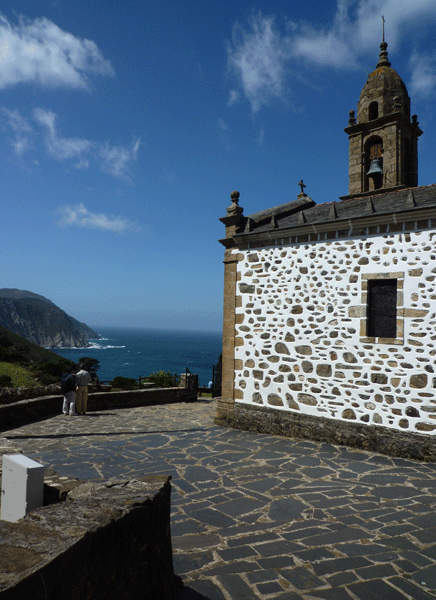
Around a bend I came to the white-washed sanctuary that guards the relics of the apostle San Andrés (Saint Andrew). The church was surprisingly small, given the size of the folklore that surrounds it. Legend says that San Andrés was distressed because so few pilgrims visited his isolated shrine, so he complained to Christ; Christ felt sorry for him and promised that nobody would enter heaven if they hadn’t gone first to San Andrés de Teixido. It was a great marketing ploy, judging by the popularity of the shrine over the last 400 years.

Many pilgrims come to Teixido to avoid making the journey after they die, but others have different motives. Some come in search of healing or love. Discarded crutches and yellowing wax body parts adorn the steps leading up to the high altar, proof of prayers granted by the saint. Miniature ships reminded me of how close the sea is and how risky the seafarer’s life. A coffin swings from the rafters, an offering from someone who prayed to the saint and avoided death. At least for then.

But there was little to keep me there so I wandered on, following a trail that led to the three-spouted Fountain of the Saint in the shaded grove below. Drink the water or take it home, I was told: it’s holy. They say the flow of the fountain never varies, winter or summer, and that the water issues from beneath the high altar of the sanctuary above. Make a wish, put a piece of bread in the water, and hope that it floats. If it does, your wish is granted. I did and it did, so perhaps it was. Time will tell.
The path led on. Where, I wondered? I walked faster now, drawn by mystery, pulled by the distant roar of the sea. What’s this? White specks dotted a fence and covered the lower limbs of trees like Christmas flocking. I had seen these clootie cloths draped on trees beside holy wells in Cornwall and Ireland: prayers and promises, hopes of healing, impressed on a piece of cloth or rag and tied around a ready receptacle. But why here? Why so many?

I slid through the clootie-covered gate and hurried down the sloping path that led through a meadow, then climbed down a short wooden ladder to another meadow. The sea still called; mystery still drew me on. The path continued. I lowered myself carefully over a low stone wall to yet another steep-pitched meadow. I followed the ever-downward path until it ended abruptly at an impenetrable row of bushes sprinkled with white clootie cloths. Waves blustered and battered against the precipitous cliffs 450 feet below. I had reached the end of the earth. What lay beyond, I wondered, where the sun sank into the vast expanse of sea?

Evergreens beckoned on one side of the meadow, boulders and a grove of gnarled trees on the other. A fresh breeze ruffled the clootie cloths. I took a deep breath and inhaled the scent of sea and pine.

A faint low moan blew through the forest. Was it just the rubbing of branches, I wondered, or had I stumbled on a powerful place—a pagan place of power long before the Christians came and claimed it for their own, building their sanctuary on the hillside high above? The air seemed to vibrate around me. Feeling a little shaky, I walked over to a lichen-covered rock sheltered under twisting trees, and sat down. A lizard scuttled across my feet. I shuddered. Unexpectedly, everything except the sea became very, very still. I held my breath, afraid to look around. It’s not for nothing they call this the “Coast of the Dead,” I thought.

Suddenly the spell broke. Two laughing children and their out-of-breath parents came into sight, hurrying down the path. I watched them for a moment, then slowly stood up, preparing to rejoin the land of the living.


Elyn Aviva is a writer, fiber artist, and transformational traveler. She is fascinated by pilgrimage and sacred sites. Her PhD in anthropology was on the modern Camino de Santiago in Spain. Aviva is co-author of Powerful Places on the Caminos de Santiago, Powerful Places in Scotland, and others in the series. To learn more, go to www.pilgrimsprocess.com and www.fiberalchemy.com


 View Photos

If you'd like to subscribe to YourLifeisaTrip.com and be notified when new articles appear, click here. It's free, it's fun, and it keeps you on the cutting edge of what our writers are thinking.

Related Posts with Thumbnails 

PrintView Printer Friendly Version

EmailEmail Article to Friend

Reader Comments (26)

Wow. Now THAT'S a moment well captured.

jules

January 18, 2010 | Unregistered Commenterjules

Surely there will be more articles by Elyn Aviva on the subject of power places. This is a wondrous article and it pulls this reader in from the first sentence, "Souls in the form of lizards ..." Then I followed her wanderings on the pathway towards the ocean. The next to the last paragraph completely captivated me, "A faint moan blew through the forest." Oh! Most excellent words. I speculate and hope that there will be many more fine articles by this author. - Anna West in Denver

January 18, 2010 | Unregistered CommenterAnna West

You have a wonderful ability to take a person with you to the places you describe. The sights, the sounds - I could even feel the lizard crossing your foot. Thank you.
Laura

January 18, 2010 | Unregistered CommenterLaura

Always a pleasure to read anything Elyn writes. I highly recommend her beautifully-woven tale, "The Journey" for those interested in Celtic mythology, the Camino Santiago and a modern story of self-discovery. I've read it twice. Available at: http://www.pilgrimsprocess.com/ourbooks.htm

January 18, 2010 | Unregistered CommenterAysha Griffin

Wonderfully evocative Elyn....I was there with you. From the picture it reminds me a lot of the Pacific coast cliffs around Jenner or Inverness CA. But the 'Coast of the Dead' it is not, although it can be windy and treacherous. Keep writing wonderful episodes in your travels and I want to hear more about the celtic history of this area and the cloothie cloths

January 18, 2010 | Unregistered CommenterSheri

we are planning more elyn aviva stories, for sure, for sure.

January 18, 2010 | Unregistered Commenterjudie

Dearest Elyn, I notice that you use plain, simple language, short words and brief sentences. That is the way to write English--it is the modern way and the best way. Don't let fluff and flowers and verbosity creep in. When you catch an adjective, kill it. No, I don't mean utterly, but kill most of them--then the rest will be valuable. They weaken when they are close together. They give strength when they are wide apart. An adjective habit, or a wordy, diffuse, flowery habit, once fastened upon a person, is as hard to get rid of as any other vice.

January 18, 2010 | Unregistered CommenterRussell Call

Wow, Elyn... Impressionante! Now I´ve REALLY got to visit San Andrés, you make it so compelling!
Best bit of travel writing Í´ve read in a very long time!

January 18, 2010 | Unregistered CommenterRebekah Scott

Hello Elyn. An excellent article, makes me want to leave tomorrow! I also agree with your friend Russel. Your writing is crisp and clean, I could almost feel the sea breeze and the whispering of the trees. So good, thank you for sharing. Linda

January 18, 2010 | Unregistered CommenterLinda Bramlette

Hi Elyn,
Nice article; I'm convinced!
Best!
Geerτ
PILGRIMSPLAZA

PS: We're closing in on The Santiago Enigma; see http://king-early-days.blogspot.com under "Summarized in a few paragraphs it all boils down to this:"

January 18, 2010 | Unregistered CommenterGeerτ Bakker

I loved the transition from the obvious surface shrine to the mystical cove down below; travellng the beckoning path of the clootie cloths to give us an authentic moment at the Coast of the Dead. Thanks for journeying there. It woke up the memory of a similar moment at a Heiau (sacred site) of the Dead in western Kauai . I could feel again the other-worldliness and quiet behind it all by reading your words in their well-timed progression.

Wilhelm

January 18, 2010 | Unregistered CommenterWilhelm Heppe

Beautiful writing that brings this beautiful place alive! Thanks Elyn

January 18, 2010 | Unregistered CommenterAnne Parker

You really bring us a sense of the sacred place through your words
Love it
Karin

January 19, 2010 | Unregistered CommenterKarin

Thanks to all of you for your lovely comments. Just to clarify--I am NOT commenting on my own article. Apparently, sometimes people are able to post as me. (Who'd have thought it would be so easy?) As long as they say positive things, I can't complain. If they start signing my checks, then I'll worry.
Elyn

January 19, 2010 | Unregistered CommenterElyn Aviva

I felt transported to the site...I could feel the stones under my fingers, could feel the breezes and smell the eucalyptus trees.......I want to read more of your work......being confined to a small house in North Hollywood right now, I crave what you have to describe. Even if we can't go there now.....we can always travel in our minds and souls.......Love, Jan

January 19, 2010 | Unregistered CommenterJan Preston Dunn

As an explorer of sacred space, I really enjoyed reading Elyn's piece on this bit at the end of the earth. I've always been fascinated by the Galacia/Irish connection, and the clooties certainly do make a connection for me.

}:-)

Sig

January 19, 2010 | Unregistered CommenterSig Lonegren

Hi Sig! You're right--there IS an interesting Galicia/Ireland connection--including the legend that long ago the settlers of Galicia invaded Ireland! Lots of Celtic-related or Celtic-tinged folklore and practices (the quemada, a flaming punch prepared in a ritual way with incantations about the spirits of the dead; the brujas or witches--I'm told they were originally Druid priestesses; the owl as psychopomp; stories of the Little People....); the remains of Celtic castros; and Celtic-style pallozas (circular stone huts with thatched roofs) in the isolated mountain villages. But the clootie cloths were new to me--and according to one source, they only started appearing maybe 10 years ago! I talk about some of this in the chapter on San Andrés in Powerful Places on the Caminos de Santiago.

January 20, 2010 | Unregistered CommenterElyn Aviva

Elyn, this is beautiful! You once told me, "If you need to read a sentence twice to get it's meaning, it is not a well written sentence." The simplicity and description of this magical place takes me with you. Love it!

January 20, 2010 | Unregistered CommenterBeth Cheville

"the owl as psychopomp"

Hi Elyn,

In 'The Way of Saint James' on Santiago's psychopompous aspects Georgiana Goddard King mentions the owl only once in volume II, book Two: The Way (Continued), chapter XI. SAHAGÚN, page 121:

"Then she fetched me back past vacant places on the outskirts, where under a long cattle-shed gypsies had lighted red fires and were cooking by the uncertain flare. It was the desolation of the owl and the hedgehog."

Could you please enlighten us further on where you found your owl as quoted above? Thank you!

Geerτ
http://pilgrimsplaza-king-index.blogspot.com
http://pilgrimsplaza-georgianas-gems.blogspot.com

January 21, 2010 | Unregistered CommenterGeerτ Bakker

What a wonderful article! Makes me want to go experience it for myself!

January 23, 2010 | Unregistered CommenterHallaj

PostPost a New Comment

Enter your information below to add a new comment.
Author Email (optional):
Author URL (optional):
Post:
 
Some HTML allowed: <a href="" title=""> <abbr title=""> <acronym title=""> <b> <blockquote cite=""> <code> <em> <i> <strike> <strong>