by Sallie Bingham


No, I don't speak Spanish. Yes, I tried - a class, some CD's, but somehow it never “took” although I live in New Mexico where perhaps half the population speaks Spanish, and my daughter-in-law and granddaughters speak Spanish, too. But somehow it never came home to me until we were taking a family Christmas vacation at one of the huge resort hotels that wall the beach in Los Cabos at the tip of the Baja Peninsula - or “Baja” as we tourists call it. Everyone who worked in the hotel spoke Spanish but none of the guests did.
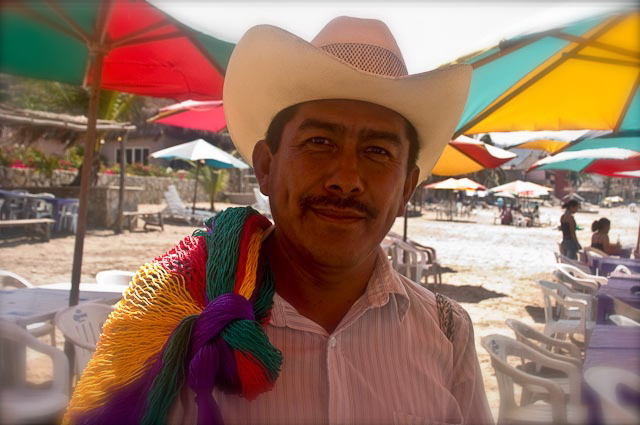
The symbol of this linguistic divide, for me, was the rope that was strung across the beach, about half way between the oceans and the throng of lounge chairs under thatched roofs. Perhaps the rope was taken down each night and put up again in the morning, but whenever I was on the beach, the rope was there. On one side, the tourists sat or lay in their lounge chairs surrounded with the usual sunbathing paraphernalia. I was one of them. On the other side, local men and women held trays of jewelry or bundles of brightly-colored serapes and looked at us. Occasionally, one would softly call out to us, but I sensed that this was probably forbidden.

They stood all day on their side the rope, or sometimes walked up and down the beach and chatted with each other. Meanwhile, we sunbathed, read, drank water, gossiped, talked on cell phones, and avoided making eye contact across the rope. During the week we were there, I never saw any tourist approach a vendor or speak to him or her or make a purchase. Yet the local vendors were there, day after day, even on Sunday.

words and photos by Elyn Aviva


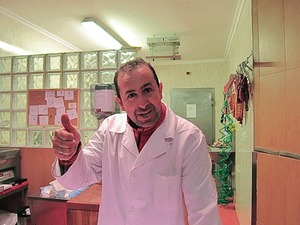
He was a good-looking guy, even though he had blood on his hands and his jacket was spattered with red stains. His eyes were intense, his smile tight, his long fingers graceful as he sharpened his knife, the thin blade scraping rhythmically against the long steel rod.

The carnicería was packed with customers, patiently impatient, enjoying Julio’s ongoing spiel, willing to wait (for wait we would) while he cut each piece of meat to order. There were five butcher shops (not counting two supermarkets) in Sahagún, the small town in northern Spain where we were living, but this was the best. I had it on good authority.

“He’s an artist,” my late friend Paca had explained. “He can slice a piece of meat so thin you can see Barcelona through it.” No small task, given that Barcelona is 500 miles to the east.

Inside the entrance to the small shop was a red ticket machine. Take a number and you will know where you stand. Or so I thought at first. But I was quickly disabused. The flashing number on the bright-lit sign above Julio’s head never changed.

“Who’s last in line?” I asked, my limited Spanish having expanded to cover such necessities. A man leaning on a cane pointed to the elderly, burgundy-haired woman beside him; she nodded. I knew my place and sat down to wait. And wait. An hour would be fast, I realized, for it was just before the holidays, and everyone was stocking up to feed the hoards of friends and relatives returning home.

Homemade chorizo sausage, marinated pork loin, pork tongues, skinned rabbits, quarters of young and slightly older lamb, whole chickens, duck pâte, smoked pork chops, soup bones, bacon, tiny quails packed close together, pig ears, beef steaks, stew meat, chunks of beef to slice into fillets—and more—were tightly packed inside the glass-fronted case that separated Julio from his customers. Another case was crammed with rounds of cheeses and heaps of packaged pork products, its flat top covered with jars of leeks and asparagus and tuna, and bottles of local fruit conserves. On the wall behind, assorted Iberian hams hung from ropes tied around their shanks.

words and photography by Shelley Seale


I hiked slowly through the fall foliage in the woods surrounding the Shuiguan Mountains, about an hour outside Beijing. Vivid orange and yellow leaves swayed on the breeze in the branches around me as I picked my way carefully along the rocky path. My footsteps were the only sound I could hear.

Suddenly, there it was. Emerging through the trees was a rocky wall just in front of me. I peered up at the top of it, thirty feet above my head. Following the path as it veered off to the left and up a steep rise, I found myself standing on a crumbling, original section of the Great Wall of China. Boulders and smaller stones were scattered wherever they had come loose from the wall, resting where they were for who knows how many years. Grass and weeds sprouted up from the remaining rocks that made up the top of the wall. This part of the Wall had not been restored since the day it was constructed over a thousand years ago; it was truly a piece of ancient, undisturbed history that lay beneath my feet and undulated across the mountains in front of me. There was no one else in sight.

I was at a private, untouched part of the Great Wall, on the grounds of the Commune Kempinski resort. A few minutes later my small group of traveling companions caught up with me, and together we walked along the wall in silence, marveling at our incredible experience of leaving the well-worn tourist trail where hordes of people clambered up steps that were built on the wall and made of rocks and plaster younger than I am. A short while later we gathered together, still the only visitors in sight, and, as the sun began to set behind the wall, we popped open a bottle of champagne to toast the end of a two-week trip.

Story by Andrea Gross; photos by Irv Green (unless otherwise noted)


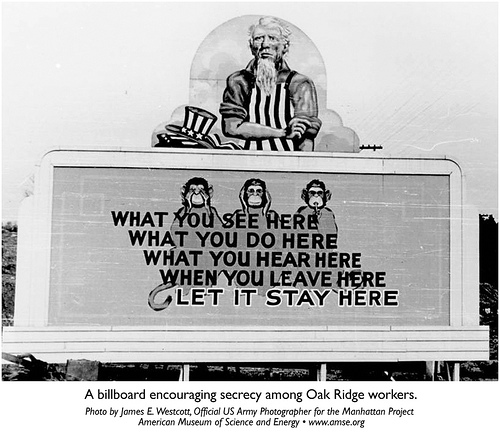
I'm in Oak Ridge, Tennessee, and the gentleman across the table from me is telling me stories about a time when most Americans, including prominent senators, did the government’s bidding because… Well, just because they trusted the government to do the right thing. No bickering. No complaints. Not even any questions. These stories blow my mind.

On the airplane en route to Tennessee, I’d read articles about more partisan squabbling in Congress, more defiant businessmen, more people trying to advance their own interests at the expense of others. Now it occurs to me that, except for a few weeks after 9/11, I can't remember a time when the people of the United States were really united.

But this gentleman is telling me that such a time existed not so very long ago. “During World War II,” he says, “extraordinary things happened,” and he continues to tell me about the “Secret City” that existed in his neck of the woods.

It happened like this: On August 2, 1939, President Roosevelt received a letter from Albert Einstein stating that there was reason to believe Nazi Germany was developing nuclear capabilities. Roosevelt realized that the United States had no choice but to do likewise — and to it faster.

Thus was born the Manhattan Project, a massive, top-secret, all-out effort by the United States government to develop nuclear capabilities.

Senators and Congressmen authorized the money without debate, knowing only that it was needed for a secret war effort. (Hmmm…. Can you imagine this happening today?)

words + photos by Rachel Dickinson

It was a yak trax morning. Well, lately every morning’s been a yak trax morning because the snow just keeps falling and if I don’t wear those metal coils on my feet, I’ll keep falling as well. I take a walk with my friend Heather at 6:00 a.m. every day. I like to walk with Heather because she owns a reflective vest and I feel like she will be the first to go when we get hit by the salt truck that comes barreling around the corner. Me, I dress in blacks and browns and blend in beautifully with the landscape and the darkness. And during deer hunting season, I don’t go anywhere without Heather because I know I look like a big deer just begging to be shot.

words + photos by Elyn Aviva

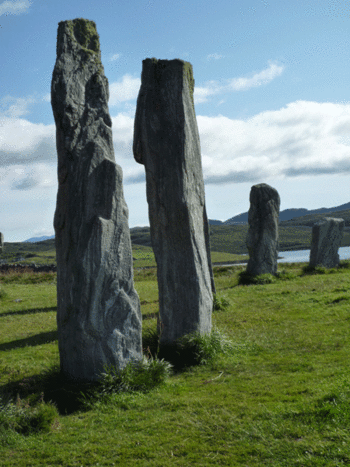
It was a light and stormy night in late June, 2006, the second light and stormy night since we had arrived at the edge of nowhere. We had traveled for days to reach the Isle of Lewis, most northern isle of the Scottish Western Isles, to witness a rare astronomical event called the Lunar Standstill. Raw and rough, the wind felt as if it had blown in from around the world—and it had, for there was nothing in the Atlantic to slow it down.

We had journeyed by bus and ferry and car to stand before the Standing Stones of Calanais (aka Callanish), to participate in the once-every-18.61 years Lunar Standstill. The pale sun would set around 11 pm, and then the full moon would skim the southern horizon, go behind Sleeping Beauty Hill, and come out again—giving the appearance of a double rising—and shine between two tall stones in the central stone ring. Archeo-astronomers believe this marking of the movements of the moon gave the builders important power 5000 years ago.

Calanais consists of a slightly squashed central ring, four radiating stone arms, and an underground, box-shaped cairn. The central megaliths stand 8-12 feet high, their uneven silhouettes resembling a Rorscharch test. Was it a temple? A cemetery? A community center? A calendar? Nobody knows for sure. The silent stones reveal their purpose slowly, if at all.

We couldn’t wait to see the Lunar Standstill, but wait we had to. The night before, icy rain had ruined our chances. We hoped for better the second night, but the moon had coyly disappeared behind a layer of clouds, only occasionally peeking out. The event was taking place right before our eyes, but we couldn’t see it.

We had been drawn to this desolate distant land because we wanted to experience what the ancients had experienced (whatever that might have been) millennia ago. We were not alone in that desire. Shivering dreadlocked tie-dyed youth chanted and drummed to the moon, equally determined to have an experience. Nor were we and they the only watchers on that wild and windy night. A choir of Church of Scotland youth clung together, courageously singing “Amazing Grace” against the encroaching pagan forces. As if intimidated by such competing claims, the moon scuddled behind another back-lit cloud and stayed there.

At the end of the stone-lined path that led north from the ring of monoliths, a group of blanket-wrapped elders sat on chairs, impatient with those who blocked their view back down the aisle. Oblivious to their muttered complaints, a photographer set up his tripod in front of them. He pointed his camera toward Sleeping Beauty, waiting for a momentary glimpse of the moon gleaming between two grey and glistening stones. They looked like giant fingers pointing at the sky.

by Judith Fein


As the holiday of hearts approaches, you’re probably thinking long-stemmed roses served on a breakfast tray in a 5-star hotel. Then, hmmm….snuggling, doing the love thang, champagne, chocolate, doing the love thang again, bundling up for a hand-holding stroll, dinner, a show and home again.  The odds are slim that your amorous thoughts turn to things that creep and crawl and fly.  But what if Cupid inspired you to do just that—think of animals for Valentine’s Day? One equatorial word immediately leaps to the lips: Galapagos.

So how, you wonder, can blue-footed boobies compete with bubbly and sinking your fork into a one-pound crustacean swimming in garlic butter on your plate?

The great Galapagean secret is that it’s no longer an either-or proposition. The entire crew of a ship can pamper you and your honey while you float toward the remote islands that young Charles Darwin visited in 1835. It’s no wonder it took him five years to collect his thoughts and formulate his theory of Evolution and survival of the fittest.  Poor Charley had to recover from his years on board the Beagle, where he suffered continually from the agony of sea-sickness. Although your cruise may not result in a great scientific breakthrough, your ship will be stabilized, you will not be tossing your petit fours, and you will be in the mood for unusual forms of aquatic and terrestrial love.

My husband, who is a thoroughbred romantic, booked us in a deluxe room on the l00-passenger Explorer II.  I had visions of walking single-file down a dark, narrow, creaking corridor and ducking into a stateroom with a metal floor and a Murphy bed.  Ah, how little I trusted my Valentine. The corridors were broader than some state roads, and the doors all shone with mahogany finishes.  Our room was carpeted, had real drapery, a huge bed, a video console, chocolates on our pillows, and—was I dreaming?—the room steward made up the room at least three times a day.  Before bed, he twisted  our yellow beach towels into the shapes of different Galapagos animals.  I think my fave was the turtle with mints for eyes.

I’ll concede that it’s not love-inducing to get up at 6:45 a.m. every morning, but you have to take a ponga (a motorized skiff) to shore to greet the fauna before they go food-hunting.  The upside is that there are several breaks during the day when you can slip off into your stateroom for a quickie, and everyone is too busy talking about the animals they’ve just seen to notice.

by Debbie Wilson

How many times have you heard someone remark, “I wish I could go to work in my pajamas”?  At the Florence, ALABAMA tourism office we went outside the office and inside the bedroom in our Casual Day at the Office concept. My assistant, Alison Stanfield, wrote a post on Facebook about how envious she was that her 10- year-old son was having pajama day at school the week before Christmas.  She mused that she wished we could have PJ day at our office. Much to her surprise, I declared the Tuesday before Christmas as PJ day.  Kids shouldn’t have all of the fun!

by Bethany Ball


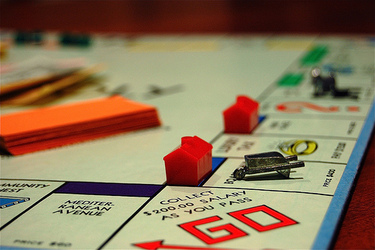
Since I took my first New York City job nearly fifteen years ago, I have always been on the wrong side of financial history. My first job was in publishing house twenty-five years old, making twenty two thousand dollars a year. This was at the time when an enterprising college grad could make one hundred and fifty thousand at a nebulous place called Anderson Consulting. Still it was a lot of money to me at the time. I’d just arrived to New York from Santa Fe where I’d been living off about half that.  Plus, in New York, I got health insurance. It wasn’t that it was such a small salary; it was just that my income wasn’t subsidized. No fiancé, no wealthy boyfriend slipping me thousand dollar checks, no parents helping me out. I was on my own. After I’d moved to another company for the princely sum of twenty six thousand, I was once again on the wrong side of things: a majority of the other companies agreed to pay their employees no lower than thirty thousand. All the other companies, that is, except mine.

Even once I found my way to the dot-com world, which bumped my salary up considerably (my managing editor laughed when I told her how much I stood to make once I left her company, “You’ll make that in ten years, here.”) I found out that one of my co-workers, younger than me and with less experience had negotiated a much larger salary then I had. She clearly knew what was what. What had seemed like so much money to me was nothing compared to what my co-workers brought home. Money was flush in those dot-com years. It was the Sex and the City years of ten-dollar Cosmos and four hundred dollar Manolo Blahniks. But I didn’t know that. I couldn’t afford cable.

And then I got married. “It’s just as easy to love a rich man as a poor man,” my mother had told me, as everyone’s mother does.  And my husband was rich. At least, he was rich to me. When we went out to dinner, he picked up the check. For the first time in my adult life I discovered the appetizer menu. We’d married right away so that he could stay in the States and now there was always money in my bank account. No more scrounging around in the floor of my closets for subway money. Things were going well. After a move to Miami and back, we got a sweet deal on the top floor of a friend’s townhouse in the West Village. Our friend rented it to us for almost half its market value. This was after my son was born and I spent every good weather day avoiding the Sex and the City tour bus lines and peering into Marc Jacobs’ window on Bleecker as I made my way to Magnolia Bakery before crossing the street to the park. I loved my sun-filled apartment, and pushing my son in his MacLaren all around the city.

by Sara Morgan


Last year I had the great fortune to receive not one, but three major personal and financial blows in my life. “Fortune”, you say?  “Are you nuts?” Nah, I just finally realized that it is the biggest challenges in life that give us the biggest opportunities.

Admittedly things have been a little rough. Most of my friends think I have gone mad. No one understands why I will not just give up this dream of mine and go get a “real job”. Some days I see their point, but the bottom line is that all I have left is my integrity. I have sold almost everything else, but my integrity is priceless.

Two months ago, when I realized that no one was buying my book about escaping Corporate America and no one was hiring me for contract jobs due to the Recession, I decided to take a chance and do something I have always wanted to do. You see, I love to help people help themselves. Empowering other people empowers me.

So, I decided to use my skills as a professional technical writer and my 15 years of experience as a software developer and create a do-it-yourself web design guide. The guide would be written in a very conversational style and would only include the bare minimum of what someone needed to know to get a professional web site up and running. I used every minute and every brain cell to pound out what I think is a pretty exceptional guide. My best work yet.

Initially, I planned on selling the guide for $25 each. Certainly a 137 page guide that was this thorough would be worth that. But last weekend, I had a burst of inspiration and decided to go a different route. In the spirit of the Internet and that information should be made free; I am giving the guide away to anyone that signs-up on my web site at www.custsolutions.net.

That’s right. I am giving it away. Most people that have downloaded it so far are amazed that I am doing this, but it makes sense to me. I know this is the only way I can truly reach the most people possible and empower them to reach for their dreams. True, I get no money and I still have no way to pay next month’s mortgage, but I got that integrity. And, that is what life is all about – at least for me it is.

by Charmaine Coimbra

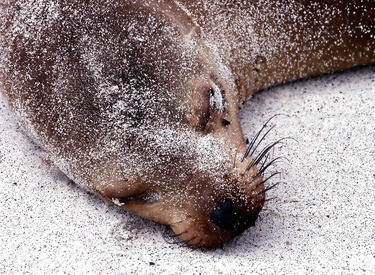
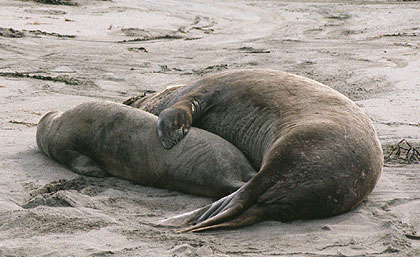
February 14 is a day for love, and if you visit the Piedras Blancas bluffs near San Simeon, California on that day, you will see more love-making on the beach than ever before.

That’s right.  I’m talking northern elephant seals. As I write (January), the adult females are birthing pups, and the way the gulls are bounding about the beach cleaning up the birthing mess, it looks like popcorn gone mad with wings.  The 2010 female and pup count far exceeds the last two years, according to stats taken by Brian Hatfield, the marine biologist on site.

Thousands of visitors from around the world flock like the gulls for the unique opportunity to watch these migratory seals give birth on the beach.  Birthing takes place once a year during the winter months, after the females make a 2500-mile migration from open sea to the Piedras Blancas rookery.

How does this relate to Valentine’s Day?  First, let me explain that female northern elephant seals are pretty much bare-flippered and pregnant most of their lives.  So, after the female gives birth, she nurses her pup for about 28 days.  (The 70- pound pup will weigh in at over 300-pounds when it’s weaned.)  She’ll turn her back on the little guy and (OMIT) now contend with a two-ton love machine, because she is now in estrus. 

Most births occur around mid-January, consequently supplying harems of females-in-estrus on February 14.  The alpha bulls, many weighing in at two-tons and about 16-feet long, have waited all year for this.  And because any given northern elephant seal bull has less than a 10% chance of ever breeding in its lifetime, they take this seriously. 

by Laura B. Weiss


“Go ahead, take a bite,” said farmer Joe Barsczewski, handing me an ear of just-picked corn.

“You mean eat it right now, without cooking it?” I asked Joe, who’s been farming 22 acres of land on the outskirts of the North Fork, Long Island town of Greenport for the last 14 years. I was dubious even though the perfectly aligned yellow kernels appeared sparklingly fresh.

But raw?

Joe, who also grows potatoes, eggplants, tomatoes and other summer crops, emptied a bushel of ears onto the stand, eying me as I took a tentative bite. Though I expected the kernels’ texture to be leathery and tough, the perky yellow globes were unexpectedly crunchy and moist—and so full of flavor they exploded in my mouth with a jolt of sugary bliss. Even that Hallowe’en perennial, candy corn, couldn’t compete with this bit of vegetable heaven.

It's January, and if you’re like me, you’re dreaming of fresh corn from the farm. On the North Fork of Long Island, an area that is two hours from New York City and dotted with farms and vineyards, Joe is just one of more than a dozen farmers who offer up impeccably fresh corn and other vegetables. 

by Judith Fein


I love Craig’s List. I really do. It has transformed the way we advertise, buy, sell and think about transactions. It’s beautiful. It’s free. I have used it so many times that I refer to the founder as Craigie. But, like the little girl with the curl, when the list is good, it is very very good, and when it is bad…well, you know.

My Craigie episode started a few months ago when my husband and I decided we desperately needed a vacation. Truth be told, I am not sure we’ve ever taken a vacation. As travel journalists and photographers, we’re always writing, shooting, taking notes and stumbling over stories, even when we don’t mean to.

But this time it was different. We were burned out from having our eyeballs glued to our computers l5 hours a day, meeting deadlines, emailing, researching. We looked at each other, and, in that silent way we sometimes communicate when we are not yakking or yukking, we knew we had to stop. For a full month.

I went to Craigie, of course, and typed in the name of a beach community in California.

There it was: the little bungalow that was waiting for us, half a block from the ocean.

It was, according to the owner, small, clean, with a spacious backyard where we could hang, escape the winter, and drink margaritas. For me, it was a done deal.

It took several weeks to get a contract. Turns out the dude who advertised with Craigie wasn’t the owner, but the renter, and this was a sublease. Fine. Also, he was doing some mysterious work or traveling in Asia and was hard to contact. Okay. His friend was handling the rental. Fine. When you have the prospect of being half a block from the ocean, you’re willing to put up with a lot. At least I am.

by Jules Older


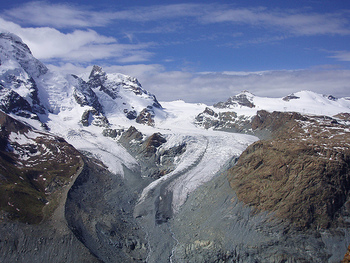
Though most Alaskans, Vermonters and Minnesotans are enjoying the unprecedented winter warmth, skiers are not. Except in freak years, like 2014 and the epic 2015, there's precious little snow falling on mountains. Rain, yes; snow — not with any consistency and not ‘when it’s supposed to.’ Sir Albert Gore, as everyone except the most recalcitrant deniers now concede, was right — climate change proved to be all-too real.

Here's where we stand in February, 2025.

Europe’s lower slopes have reverted to pasture; in the foothills of the Alps, goats have replaced skiers. New Zealand’s already short season is, most years, down to three weeks. There's no more skiing in Australia except for water skiing.

But snow skiing has almost saved Dubai. Even with its current tourism woes, winter sport is thriving there; they now have sixteen indoor hills open 24/7 and three more under construction.

American skiers look at Dubai with open envy. In New England, the only ski resorts left are Killington and Jay Peak in Vermont, Sugarloaf and the newly important Saddleback in Maine. All four have pretty much given up opening before New Years; all four are spending big bucks promoting spring skiing. Slogan: “April is way cool!”

Except for Jiminy Peak, which had the foresight to install plastic bristles in 2118, and Wachusett, which covered itself with a dome the following year, there is not a single outdoor ski area left in southern New England.

The entire mid-Atlantic ski business has been wiped out, along with most of the Midwest. In the West, New Mexico, southern Utah and with two exceptions, California, are ski-free zones.

In California, there's still lift-accessed snow on what was the top of Mammoth Mountain and, during relatively cold winters, on Kirkwood’s upper slopes. In Utah, Brian Head is now “the country’s biggest mountain-bike terrain park.” California’s Heavenly promotes “big-mountain living.” Colorado’s Vail is “Your mountain dream.” Everybody uses “mountain;” only the lucky few mention “snow.”

words + photos by Alan Fritzberg


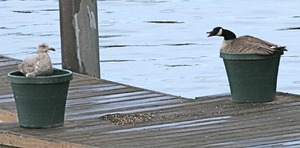
OMG.  There’s a goose sitting in a flowerpot on the neighbor’s dock!  There began a month plus of watching a goose nesting in what would seem like an odd, very visible and seemingly vulnerable location for the process on the shore of Lake Whatcom in Bellingham, Washington. 

My 1950s boyhood memories of Canada geese are of my father dreaming of seeing one close enough to have a shot at. Near our house between Bellingham and the Canadian border they were usually seen only high overhead.

Nowadays, as we all know, geese are seemingly everywhere there is water and, especially, freshly cut grass.

The geese we see in our area are nonmigratory residents, thanks to the U. S. Department of Fish and Wildlife. In response to declining goose populations in the first half of the 20th century, eggs were incubated separately from parents so the goslings could be raised without being taught to migrate. Success in this recovery endeavor was defined as improved hunting opportunities.

Being in the habit of shooing geese off the property, how should I react to a goose that has decided to nest in a large flowerpot on a neighbor’s dock? My first inclination was to move the goose along to the next grassy yard.

Our neighbor who put the flowerpot on the dock was excited to see a goose sitting in it. I realized it was not my role to call a halt or try to figure out how to oil the eggs or whatever one does to un-fertilize them in order to make a small impact in retarding the population growth of our western resident Branta Canadensis moffitti.

Questions Arose

Was the goose a young first timer and didn’t know any better? Could it actually nest in a 15-inch diameter flowerpot and incubate eggs to hatching status? Was it vulnerable in so conspicuous a spot?

Plane Talk: Got a question? Ask the Captain!

Do you have a question about airline safety, flight etiquette, jet lag, or air travel in general? Submit your question and look for answers in a future column.

by W. M. Wiggins

What did you see as the problem in the American Airlines Jamaica runway accident? 


First, I saw the problem, landing with a tailwind (possibly) out of limits. Then I see what appears to be some of the best publications relations in the realm of corporate aviation.

 The following is my opinion:

Basic airplane 101 says, point that little puppy (the jet or “de plane”, “de plane” ) into the wind for all takeoffs and landings.

The “Specs” or specifications for the Boeing 737-800 say max takeoff / landing tailwind component is 10 knots. Please note, it does NOT say About, Sorta’or Kinda’10 kts. It says 10 kts. This will be important later.

Then the  “Specs” goes on to say…There “May” be 15kts ( tailwind) as customer option. Hmmm? Seems just a tad contradictory, yes?

Uh, NO, not really.

What that means, basically, is that Boeing is “on the hook legally” for that 10 kt tailwind number.

Now, but, but, but what about that 15 kts?

Well, that’s “Show me the $$ money $$ time.

words + slideshow by Paul Ross

I’ve seen most of the oceans of the world from boats big and small, craft commercial and military. I’ve been in a submarine, dove the wall of a 2-mile deep sea trench in the mid-Pacific, watched whales in the Arctic and sunsets on islands, atolls and from shores distant and domestic. But not until recently did I stand at the edge of the ocean and notice that waves have personalities. Some are feminine and lap at or teasingly tickle the beach while others impatiently charge the shore in an alpha male display. There are lofty and proud rollers, menacingly dark gatherers who build and build, creating discomforting uncertainty with their indefinable limit and unfathomable purpose. Some are mere sighs of the sea; indifferently swelling and quelling as if to shrug or just take a momentary look around. Sibling rivalry waves, born of the same mother roll, will playfully clash into each other and collapse into sparkling foam. Stolid workman waves dutifully pound away at rocks in destruction zones even more permanent than those of the streets of New York. Still others are real sports: faking one way, breaking another and nimbly dodging surfers as if they were opposing football players. And there are golf waves with their long impressive drives decelerating to a controlled stop. How ‘bout those NBA ones? Taking their time moving down court, coolly surveying and assessing the scene before exploding in a sudden move. 

Health-wise, there are asthmatic waves with long, labored and drawn- out aspirations. Neurotic waves indecisively fall apart in pieces, attempting a regroup even as other sections are curling inward. 

Egocentric waves applaud their own performance. 

Some are shy, don’t want to be noticed, and aren’t. 

by Don Mankin

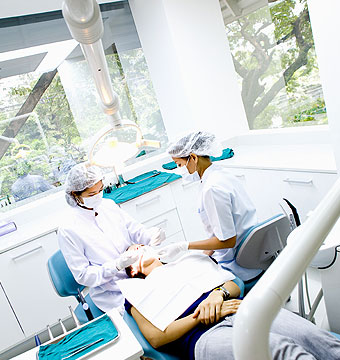
It’s Colts 13, Houston 0 as the half winds down. My wife and I are watching Peyton Manning lead the Colts to yet another NFL victory on a big flat screen TV. Nothing strange about this, except it's Wednesday afternoon and we are sitting in the lobby of the Dental Hospital in the heart of one of the poshest districts in Bangkok. Like many other cash-strapped seniors, we are dipping our toes into the wave of the future with our first adventure in medical/dental tourism.

This is not my first dental experience in Thailand. In the late 1990s, on a flight to Thailand for a business trip, I cracked a temporary bridge eating some nuts. It didn’t hurt and wasn’t much of a problem at first, but as I talked and chewed, the sharp edge of the broken bridge jabbed into my tongue. The easy solution – don’t eat or talk for two weeks -- was not an option, so the first thing I did upon landing in Chiang Mai was to ask my colleague who met me at the airport to recommend a dentist.

The dentist office did not look promising. It was dark and dingy with equipment I hadn’t seen in years. The possibility of pain was the least of my worries, though. It was at the height of concern about the spread of AIDS throughout SE Asia, and I wasn’t at all sure that I wouldn’t get the disease from this hapless dental adventure. My heart started pounding and I broke out into a sweat. “Should I leave and risk looking like a wimp and insulting my colleague,” I asked myself, “or should I stay and risk pain and death?” The risk of embarrassment won out over the risk of pain and death, as it usually does for me.

As the dentist lowered my chair to get a better look, I gulped, or at least the closest thing to a gulp given the wad of cotton in my mouth. I caught a glimpse of my colleague in the waiting room smiling and waving to me as if I had nothing to fear. In just a few seconds I realized that he was right.

words + photos by Elyn Aviva

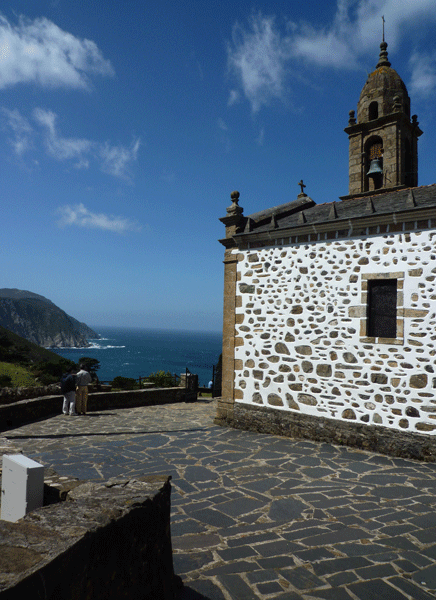
Souls in the form of lizards and snakes slither their way to the seashore sanctuary of San Andrés de Teixido in northwestern Spain. At least that’s what local Galician folklore claims about this hard-to-reach pilgrimage shrine, perched on a cliff on the Costa da Morte. “If you don’t go there before you die, you’ll have to go there afterwards”—or so the legends assert. So why not go now, I thought to myself? It would certainly be simpler and more convenient. Besides, I was intrigued by these Celtic-tinged stories of transmigration of souls in what appears to be a deeply Catholic country.

Rather than slither, I went by car, wending my way up and around curvaceous roads shaded by huge eucalyptus trees that swayed in the strong Atlantic breeze. Their medicinal scent filled the air. I pulled over near a TV repeater tower to walk a short stretch of the original pilgrims’ path, careful not to kill any insects I encountered en route—after all, they might be souls on pilgrimage. Or so the legend goes.

At last I reached the tiny village of San Andrés and left the car in the large parking lot at the outskirts. I strolled down the narrow lane lined with souvenir stands selling wax ex-votos in the shape of body parts, brightly painted hard-baked bread-dough offerings, and tiny bundles of hierba de enamorar, a local pink flower that is supposed to be a love potion. Something for everyone, I thought. But was there anything here for me?

Around a bend I came to the white-washed sanctuary that guards the relics of the apostle San Andrés (Saint Andrew). The church was surprisingly small, given the size of the folklore that surrounds it. Legend says that San Andrés was distressed because so few pilgrims visited his isolated shrine, so he complained to Christ; Christ felt sorry for him and promised that nobody would enter heaven if they hadn’t gone first to San Andrés de Teixido. It was a great marketing ploy, judging by the popularity of the shrine over the last 400 years.