by Elizabeth Weinstein


“If I have to hear one more time about that roast chicken your father had in Tuscany....” my husband says, shaking his head. He feigns disgust, but in truth my husband is amused at the way my family compares every meal we eat to some better meal we had once upon a time. And the best of those meals were always in Italy. The ‘roast chicken in Tuscany’ has become our tagline for the holy grail—the holy food grail.

 

My parents lived in Italy a generation ago and, culinarily speaking, came of age there.  During our growing-up, my brother and I were lucky enough to spend a year and several seasons in that country of hot, meaty broths that simultaneously console and inspire; fresh spinach with warm, oily garlic; pan-fried steaks bright with lemon and salt; and tortellini alla panna that could make you cry.

But it is indeed the roast chicken that does a Marcel Proust number on me—or rather would, if only I could have a bite of that chicken I ate 45 years ago at a restaurant called Cecco’s in Pescia. Just tonight if I could have a taste of pollo al mattone, a fresh chicken flattened whole between two bricks and roasted crisp and succulent on a spit with—with what seasonings? Was it really only salt?—then I would remember what it was like to be five years old and travelling with my parents and my big brother from Lucca back to our temporary home in Florence. I would be able to feel again the warmth of being safe with my family and at home in a foreign country.

by Elyn Aviva


When we told an English friend that we were going to Wales for a few weeks, he looked at us with undisguised pity.

“Bring your own food,” he urged.

“Surely you’re joking!” I replied with a laugh.

He shook his head grimly. “Trust me. Bring your own food.”

I have celiac disease, and finding gluten-free (GF) restaurant food can be a challenge—even in countries renowned for their cuisine. I must stay away from wheat, barley, rye, kamut, and spelt in all forms, including bread and flour. What travails would await me in Wales, I could only imagine.

Filled with foreboding, my husband, Gary, and I headed off to Wales to do research for our “Powerful Places Guidebooks” series. Late at night we arrived in Cardiff, capital of Wales, and headed to our B&B. Actually, it was a “B” with only one “B”: bed. Our host offered us an alternative to a homemade breakfast: discount coupons for breakfast at the hotel across the street.

The next morning, we strolled over to the hotel’s unprepossessing side entrance, pushed the door open, and walked on faded carpet to the shabby dining room. Plates displaying the gritty remains of congealed eggs, burnt toast, and greasy bacon were piled on the tables. Hesitantly, we approached the barren breakfast buffet. The plastic cereal bins were nearly empty, and the bowl of fruit salad held nothing but a few wrinkled orange slices stuck to the bottom. Apparently, we had missed the early morning breakfast rush. Judging by the unappetizing remains, it was just as well. We began to worry. Maybe our friend had been correct about Welsh food.


Don't you wish you had a travel expert who could help you plan the experience of lifetime?  Someone who knows the best way to get off the beaten trail, has insider's information on the best places to eat, stay, sail, fly, have adventures, relax?  A pro who can tell you what to miss, skip, what's not worth your time and money?  The most wallet-friendly way to get away from it all?

Get your travel planning questions ready! Answering your queries in our new ASK A TRAVEL AGENT column is, Susan Kelly, a 25-year veteran travel agent, who has spent the better part of her life helping travelers plan memorable journeys and discover the world. 

She has her finger on the pulse of worldwide travel, has access to exclusive deals for our readers, and we are thrilled that Susan is bringing her expertise and passion to our YourLifeIsATrip family.

We’ve experienced first-hand how Susan’s attention to detail, global resources, and industry connections can save you money, time, and emotional distress, but thought we'd start the dialogue with the question everyone is asking these days…

WHY DO I NEED A TRAVEL AGENT? Hasn't the Internet made them obsolete?


by Jim Terr 

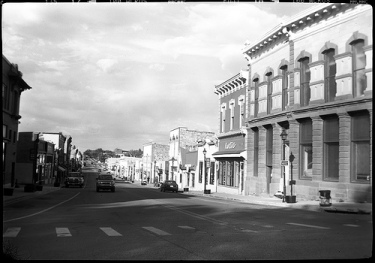
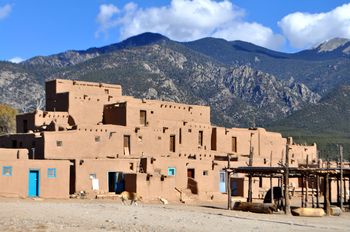
I had lived in Santa Fe, New Mexico for 23 years before it occurred to me to offer to move back to Las Vegas, New Mexico (the “original” Las Vegas!), 65 miles east, where I was raised, to help care for my mom, aged 92 at the time.

photo by jonnyphoto via flickr.comMy brother had been doing the honors (living with her, in her beautiful red-brick Victorian we were raised in) for a year, and I thought I’d offer to relieve him. My mom couldn’t believe my offer, recalling that a year earlier, when she had asked me if I’d like to move over there, I had responded “I’d rather slit my wrists.” 

My suicidal reluctance had been due to my attitude that Santa Fe was fascinating, culturally alive, hip, filled with beautiful, interesting people and romantic prospects, whereas Las Vegas (population 15,000) was insular, uninteresting, provincial, stagnant. 

As I was cleaning up to move out of the place I was living in, my ever-active songwriting mind was generating a beautiful tribute song about Las Vegas, my home town, perhaps as a coping mechanism, a reflection of my deeper excitement about moving back there despite my well-developed bad attitudes about the place.  

Now, a little over six months since moving back to Las Vegas, I am able to see more clearly what a tremendous transition was involved in moving back – and in gradually overcoming the horrible attitudes I had developed about my dear little old home town.

by Eric Lucas


“So, how does it feel to be in your homeland?”

My wife, Leslie, looks at me inquisitively.

Tindari by Leslie ForsbergWe’re visiting Tindari, Sicily, where the Black Madonna of Tindari hangs in a cool-stone basilica on an olive-scrub headland overlooking the Tyrrhenian Sea. Beside the Madonna is an equally ebony Christ hanging on a crucifix. Up the road is a theater used by Greeks and Romans; stone seats persist on a rocky hillside, 2,000 years after they were first set down.

“She is known as the ‘Black Madonna of the Orient’,” our Sicilian guide, Lita, explains about the sepia-hued sculpture in the basilica’s huge bronze altar. “That means ‘from the east.’ In this case, Byzantium. So many, many people have come through Sicily over the centuries.”

And many have left.

“I’m Sicilian,” I tell Lita. She raises her eyebrows, looks me up and down. I hope I pass inspection: oxhide skin; walnut eyes; bones like the old olive trees nearby. She nods.

“One quarter Sicilian,” I clarify. “My great-grandparents came from a village above Palermo.

by Sylvia Fox

For the past 10 years - more if you include summers - Michael and I have chosen to live what my parents would have called a 'bohemian life' that meant living with limited utilities, limited comfort.

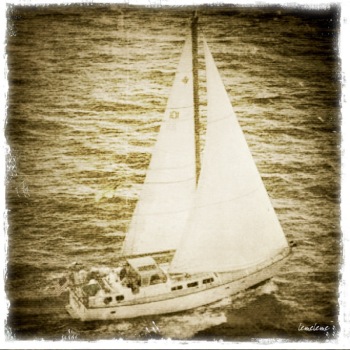
In 2000, we impulsively sold our home in Sacramento, California and bought a 48’ cruising sailboat with plans to unplug, untie and live a less traditional lifestyle. The impetus, in hindsight, was having our youngest child move out to go to college. 

As I wiped a tear away while I said goodbye, my other thought was ‘My turn!’

And off we went --- sailing out under the Golden Gate Bridge, turning left and heading south until the butter started to melt.

But over the last decade, whether we were cruising California and Pacific Mexico aboard our 48' Maple Leaf sailboat, Sabbatical, or living in a home we later built in a rural surf village on a Pacific beach in Mexico or spending summers in our 100-year-old lake cottage in rural upstate New York, we found we had to constantly monitored our usage of what most Americans take for granted: water, sewage, gas, and electric. And garbage.

We had to know what we had, what we used, what we stored because of the lifestyle we had accidentally chosen when we stumbled into our grand adventure.

by Vera Marie Badertscher


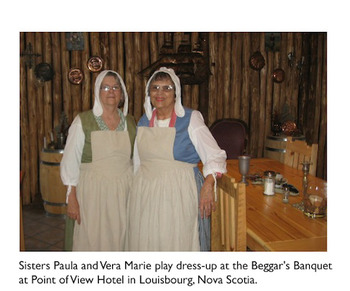
On our first trip together, we covered only a few blocks in a neighborhood of two-story white wooden houses in Columbus Ohio.  I was pushing my sister Paula's stroller. (Ask her. She would no doubt  say that I was always pushy.) At a few months old, she was oblivious to the great world around us--the bulbous cars parked along the street, the empty lot, dusty in the summer sun, or the brick store buildings up ahead on Cleveland Avenue. I, on the other hand, being ten years older, ten and a half when she was only six months old, I knew about everything.

As I walked, and she patted her chubby hands together, I daydreamed about how she would grow up with fond memories of her loving big sister and be eternally grateful for my attention and care. (Always about me, wasn't it, Paula?)  

These little walks down the block were definitely not the only trips we took as children.  Our parents loved to load up the car and go--most anywhere. Sometimes long car trips, sometimes just a drive down to the Scioto River for a picnic. On Sunday drives in the Ohio countryside, seeing the landscape between our father's salt and pepper crewcut hair and our mother's black bun, we would shout out “Go left” or “Go right” or “Go straight” at each interseciton--a kind of sibling Mapquest. It was a democratic route finding that our dad adventurously accepted.  “Go” was the operative word.

by Elyn Aviva

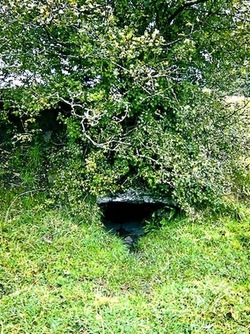
Even photos of the Cave of the Cats gave me the willies. I wasn’t going to enter it, not if you paid me. I was sure of that. My companions could go in if they wanted, but not me. We sloshed through the wet field to the entrance, a dark inverted triangle almost hidden by an overgrown thorn bush. A gash, a hole in Mother Earth. “No way,” I muttered, shaking my head. Jack, flashlight in hand, offered to go in first, and I watched him slither into the tight-fitting slit.

County Roscommon in western Ireland has a reputation for being boring, but it is anything but. The Rathcroghan complex has been a powerful place since the Neolithic, roughly 6000 years ago. It is an enigmatic landscape shrouded in myth, the burial place of long-forgotten heroes and the kings and queens of Connacht. It is one of the legendary “Celtic Royal Sites” of Ireland, ranking with the better-known Hill of Tara. Like Tara, Rathcroghan unites legend with history. It includes over 200 sites: ancient earthworks, tumuli, ceremonial avenues, ring forts, standing stones, the remains of a Druid school, holy wells, and caves. We’d come for the caves—one in particular, the Cave of the Cats.

Oweynagat (pronounced “Oween-ne-gat” or “UUvnaGOTCH”) or the Cave of the Cats is a spooky place, filled with powerful energies both of the earth and of the Otherworld. The Morrigan, Celtic goddess of death, destruction, and passion, is said to reside within.

by Jules Older

For travelers, some things are essential. Others should be left at home or not acquired in the first place. Here’s this year’s compilation of things you need and one thing you don’t.

The outdoors maxim, “Take nothing but pictures; leave nothing but footprints,” is where we’ll start.

TRAVEL ESSENTIAL #1

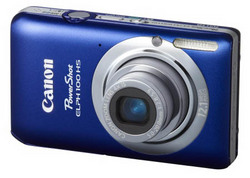
If you're gonna take pictures, I've got a camera for you. It’s small enough to stick in your pocket, light enough to take on a mountain climb, cheap enough to let you pay your mortgage … and powerful enough to blow you away. It blew me away, and I'm used to great cameras in small packages.

The camera in question is the Canon PowerShot ELPH 100 HS. It weighs less than five ounces, fits in a shirt pocket, and costs less than $200. But its real strength lies in what it can do.

Video? Full hi-def. Sound? Impossibly good — doubly so for a camera with such a tiny microphone. Low-light capability? Still can't believe what I've captured in gloomy rooms. Zoom lens? Big zoom but loses sharpness when you really pull in that distant egret. Viewfinder? No, but you'd better get used to that. Like the typewriter or phonograph, the viewfinder is a dying species.

After testing the 100 HS on snow and off, in two hemispheres, I pronounce it the best small camera I've ever tried. And the best buy. www.canon.com

TRAVEL ESSENTIAL #2 

From pictures to footprints. I've been testing two shoes — one made for walking and one for running. My first question: Does that designation really make a difference?

by Edie Jarolim

Many years ago, I went to Spain with a man who turned out to be an Ugly American. The beer was never cold enough for him and he often mangled the language, but got annoyed at even my mildest attempts at correction.  So I kept my mouth shut when, in a bar in Barcelona, he loudly insisted on a “servicio frio, muy frio” rather than a chilled cerveza. The bartender, not comprehending why anyone would demand a very cold bathroom, nevertheless pointed him towards the men’s room.

These days, I mostly travel with my small terrier mix, Frankie. He rarely embarrasses me and never by being arrogant. But Frankie presents the opposite problem to my Spain experience: that of the very hot bathroom.

Let me backtrack a bit.

It’s almost an annual tradition, my summer drive from Tucson to San Diego, started when I moved from Manhattan to Arizona nearly 20 years ago. I go to escape the triple digit desert heat and to visit friends I made when I was doing dissertation research at the University of California, San Diego.

Once you get on to I-8 from the soul destroying I-10, the drive, through pristine swathes of Sonoran Desert, is spectacular. Few people slow down to enjoy the view, however. Keeping up with the traffic flow means going about 85mph. I’d zip along until I reached Yuma -- at the Arizona/California border and about the halfway point in the seven-hour drive -- and get gas at one of the many convenience store/stations clustered near the turnoff and use the bathroom. 

At least that’s what I did until I got Frankie, my first dog, a few years ago.

Seven Years Younger: Life On Ethiopia Time

words + photos by Maureen Magee

Time zones, the International Date Line and jet lag all contribute to my feeling disoriented when traveling. Date lines especially – leaving home on a Tuesday and arriving on the Monday before I left definitely throws me for a loop.

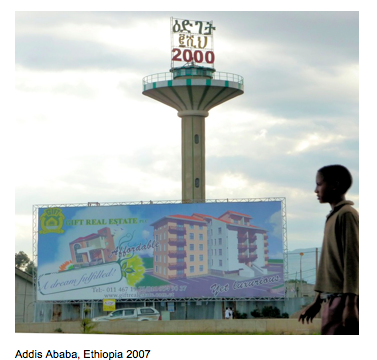
But what about when the traveler leaves home in 2011 and arrives in 2004?

It happens all the time – when traveling to Ethiopia. Once you disembark in Addis Ababa, you will be at least 7 years younger.

My first trip to this time-estranged nation was in September, 1999.  The airport was festively decked out with banners proclaiming some kind of celebration, followed by “1993!” I couldn’t speak or read Amharic, so the actual celebration was a mystery – but I figured it must have been a heck of an important party, if Ethiopians left the banners up for 7 years.

My guide greeted me with a standard “Hello”, followed by a joyous  “Happy New Year!” After 24 hours in transit, I was too tired to question this and thought, who knows – maybe in Ethiopia, everyone is welcomed with a New Years greeting – even if it is 9 months later.  One never knows in other cultures…

Recently, researchers wanted to test the effects of aging. So what did they do? They put young people in body suits that restricted their eyesight, hobbled their movement, and diminished their hearing. The measurements for the suit were based on the supposed physicality of a 74 year old. When I read this I was 74 and it made me so mad I decided I would celebrate my upcoming 75th birthday in an age-affirming way.

My Three Worlds

by Richard Rossner

"What a long, strange trip it’s been."- Robert Hunter, The Grateful Dead

Life is a trip.  It the biggest journey anyone ever makes.  And how do you prepare for the journey?  You don’t.  You can’t.  Oh, you may go to life’s Tourist Information Center, a.k.a., school, but it doesn’t really prepare you for what actually happens.  It’s kind of like looking at a Rand McNally map to get an idea of what it is like standing on the rim of the Grand Canyon.  It’s not even close to the experience.  In fact, life is such a strange animal, that you may only be able to begin to understand it in retrospect.

I am 60 years of age.  I don’t feel old.  I feel like the same person I was when I was seven, seventeen, or twenty-seven.

Let me amend that comment.  I feel the same, but some things are definitely different.  Uncomfortably different.  Maybe even standing on the cusp of disturbingly different.

When I tried to think my way through this puzzle, I realized a universal truth.  During the course of our life, I decided that we live and take a touring trip through three different worlds.  The Hindus call them Brahma, Vishnu, and Shiva.  Creation, Maintenance, Destruction.  I call it a hard lesson to learn that requires a lifetime to really understand.

The first world is the world we are born into.  It is the world of our parents. 

by Madeleine Clute


To many teenagers, owning a car is a quintessential part of the American dream. A car is freedom, fun, and speed rolled into one machine. Ideally, these tickets to freedom come in sleek, shiny, perfectly polished bodies, with hundreds of horses under the hood. My freedom came in a slightly different package. My package lacked both airbags and anti-lock brakes, and was several years my senior, but nevertheless brought me more happiness than any newer car could have.

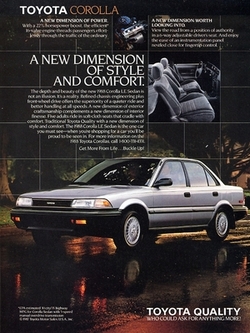
1988 Corolla AdvertisementThe car that would eventually become known as “Cosmo” was born in 1988. It was a powder blue Corolla, with a matching blue cloth interior—a decorative choice only the ‘80s could bless. My aunt, then in her mid twenties, bought the car with little knowledge it would eventually belong to her still unborn niece. She drove it for several years, before selling it my grandfather. My grandfather then sold it to my uncle, who at the time was a college student. He drove it for a decade or so, and once married, sold it back to my grandfather, who continued to drive it for another nine years. Upon getting my license, I searched for a car that was within my price range, as my parents had made it clear that if I wanted a car of my own, I would have to finance the endeavor myself. Unfortunately, I found no cars that I could insure, afford, and buy gas for. My dream was deferred for a year. The past summer however, on a college visit, my mom and I stopped at my grandparents’ house, and I noticed that, as my grandfather is somewhat of a car enthusiast, they had accumulated four cars.

by Eric Lucas


Hardly anything seems secret about a kernel of blue corn. It’s the size and shape of a baby’s tooth, the indigo color of ocean dusk, not rock-hard but sturdy, like old pine.

Such a seed would be a secret, were it a product of American industrial agriculture—patented, engineered at a molecular level, sold under some trade name like Blue 7X-RR. You would pay a large Midwestern company to have some; you’d use huge machines like science fiction robots to lay it in the ground; pour on it chemicals with carbon-chain formulas as long as Finnish words; autoclave it into foods as artificial as plastic. And you’d get your pants sued off if you attempted to replicate it or reproduce it in any way.

Photo by Manya Kaczkowski, 2010But the handful of blue corn seeds I’m holding represent a gift from, first of all, Robert Mirabal, a Taos Pueblo resident; also a gift from two millennia and the ground on which a billion people live. Corn is the bedrock of civilization in the Western Hemisphere. It built a dozen empires in Mexico and South America; helped create two dozen thriving cities in the desert Southwest about which Spanish explorers marveled so much that their colonizer, Don Juan de Oñate, declared his conquest a “kingdom.” Nuevo Mexico; it’s called New Mexico now, but still part of the kingdom of corn. And the seeds Mirabal has given me are no secret, just gifts from that kingdom’s treasure.


words + photos by Don Mankin

My two Teva-clad feet poked above the water, framing the view of the mouth of the cove spilling into the broad channel before us. The silhouettes of several tree-covered islands and mountains overlapped in different shades of pastel and receded in the distance. I was floating on my back in the waters of coastal British Columbia. Not exactly the Caribbean – no palm trees, no rum drinks with paper umbrellas, and the water temperature was more than a tad or two colder. But the water was warm enough for a late afternoon swim, the scenery was more dramatic, and there was no one else to be seen other than my four sea kayak companions relaxing after a long day of paddling in the warm bright sunshine of the aptly named Sunshine Coast.

The Sunshine Coast is just a relatively short drive and an even shorter flight northwest of Vancouver. It’s easily accessible but still feels somewhat remote -- most of the coast above Powell River, the “urban” center of the region, can only be reached by boat or floatplane. Like almost all of British Columbia's coast, it is strikingly beautiful -- islands of all sizes covered in Douglas fir, hemlock, and cedar; narrow inlets and fjords indenting the rugged coastline; and jagged snow-capped mountains in the distance framing long views across wide sounds. But unlike most of the B.C. coast, the Sunshine Coast is in the rain shadow of the low mountains of Vancouver Island to the west, so the weather is usually sunny, dry and warm, sometimes very warm.

Two Ex-Pats in Girona, Catalonia

words + photos by Elyn Aviva


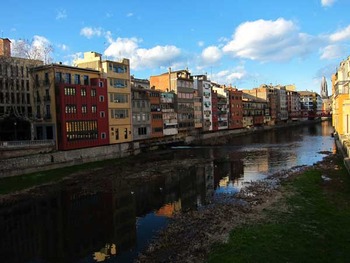
“I can’t believe we live here!” I said to Gary as I stared in fascination at the multicolored reflections dancing over the rippling surface of the Onyar River.

River OnyarHe squeezed my hand and leaned over the railing of the stone bridge. Ducks floated by, luminous in the evening light. “I know just what you mean,” he replied. “Who’d have thought that what started off as a whim would end up being such an adventure?”

I nodded, admiring how the brightly lit cathedral spires were silhouetted against the velvet black sky. I sighed, contentedly. Then, hand in hand, Gary and I strolled across the medieval bridge that divides one part of Girona from the other. We walked down the Rambla and sat down at a sidewalk café. We ordered a cortado, a fragrant cup of espresso laced with a touch of milk, and an artisan beer. We looked at each other and grinned. Ah, what a life.

Just two years earlier Gary and I had been pondering what to do next with our lives. We knew we enjoyed traveling in Europe and wanted to do more of it with less hassle. Why not move to Europe for a few years, I suggested. We weren’t getting any younger. We had good health, enough money, a love of adventure, and much to be grateful for. If not now, when? Gary agreed, and we began making plans to move to Spain, a country we had lived in briefly once before.


words and photography by Aysha Griffin


“Aren’t you afraid?” and “Isn’t it dangerous?” These were the consistent questions posed by friends and family upon hearing I had booked a trip to Mexico. From my standpoint, it was a matter of avoiding winter’s cold, pursuing Spanish language studies and visiting American friends in San Miguel de Allende, a picturesque colonial city located in Mexico’s central state of Guanajuato.

San Miguel de Allende, MexicoWithout any fear I flew from Albuquerque to Leon-Guanajuato Airport, via Houston, avoiding any border violence issues, and a 90-minute shuttle bus ride delivered me to this established and renowned cultural enclave of ex-pats and snowbirds. But the question of danger and safety in Mexico is not an easy or simple one to answer.

There is violence in Mexico, as everywhere. I recall an Australian friend who, landing in L.A. for his first trip to the U.S., called to ask if he should buy a gun – a reasonable question given the FBI estimate of over 200 million privately-owned firearms.

Americans – with our recent history of internal terrorism (Oklahoma City), external terrorism (September 11th), intentional public shootings (Tucson supermarket), serial murderers, drive-by shootings, rapes and other domestic violence; with handgun murders a daily occurrence in U.S. cities, and the largest prison population in the world – are hardly in a position to point fingers at the dangers abroad.

However, there is something different happening in Mexico. At the core are not just anger, political intolerance, insanity and psychopathic behavior, but money and turf war power, with illegal drugs (primarily marijuana) as the medium.

Thirty years ago, when I lived and traveled in Mexico for six months, handguns were illegal and even the police were gunless. At that time, Mexico was an extremely safe place in regard to violent crime. Corruption, usually in the form of bribes to officials, was a known, accepted and non-violent interaction. That was two generations ago and the world has changed in countless ways.