The Magical Dunes of White Sands

words + photos by Jean Kepler Ross

They say one picture is worth a thousand words. I believe being there is worth a thousand pictures.

For several years, I edited a travel guide about New Mexico and saw many photos of the gorgeous white sand dunes in southern New Mexico, known as White Sands. Each photo illustrated the beauty of the dunes - sensuous mounds of sand, blooming yuccas, delicate lavender wildflowers, kids jumping off the dunes into space...it all intrigued me. I traveled in that area a few times but never had a chance to actually visit White Sands until a few weeks ago.

by Silvia Pe


We were all children once. Childhood is the time of dreams and fantasies, when our imagination craves great adventures. I wonder if there’s a child who has never dreamt of becoming the king of an enchanted, beautiful castle? It was my dream when I was six.

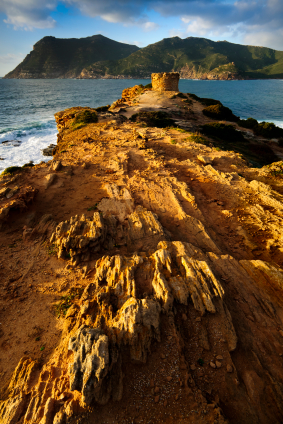
I grew up in Sardinia, listening to the legends of the proud guardians of the Sardinian coastline. My favourite locations were the coastal towers: They’re scattered along the edges of the whole island, from Cagliari to Alghero, from Oristano to Siniscola, placed to form a big protective circle. My Sardinian history teacher was my grandfather, an old fashioned sailor.

He was a charming middle-aged man. His broad shoulders and rather serious demeanor gave him an authoritarian look, but he had kind eyes. He loved to enchant me by gesturing with his knotty hands, telling me about the Sardinian silent watchers… Built to resist the pirate’s incursions, the towers were managed, equipped and defended by the Royal Tower Administration, a proto-agency based in Cagliari. A stone in Uras dating back to 1546 stands as a witness of one of the incursions by the infamous Red Beard, or Barbarossa as we call him (his real name being Khayr al-Din).

The towers were placed in a way that allowed the watchers to communicate using visuals and sounds, without leaving their stations… a little bit like when I was in front of my grandpa and my thoughts started running as if into a dream world.

by Jules Older


Sure, I wanted to go to San Francisco. Cable cars, Chinatown, Golden Gate… and something more. Daughter Willow had moved to the Haight district, which in my day was the hippie epicenter of the world. What a chance to introduce Willow to her dad’s own, personal history! So I signed us both up for something called the Haight-Ashbury Hippie History Bus Tour.

Along with four 20-year-olds — I think they were history students — Willow and I climbed aboard the bus — the psychedelic VW bus — owned and operated by tour leader, Hippie Bob.

H.B. was in his fifties. He wore a long, graying ponytail and those little, round John Lennon glasses. He had on enough love beads to serve as a flotation device, and he smelled of a familiar herb; maybe it was patchouli. Maybe not. 

Just the guy to teach my daughter modern American history. 

“Hippies like me came out to the Haight for the Summer of Love,” Hippie Bob began. “We lived in communes in big old houses like the ones on this street.”

“When was the Summer of Love, Bob?” Willow asked. 

“In the sixties, man. Definitely in the sixties. And call me Hippie Bob. That’s my handle, you dig?”

Willow looked puzzled. “I, uh, dig, but when in the sixties, Bo — Hippie Bob?”

“I dunno. We weren't all hung up with numbers and dates and stuff back then. If it feels good, do it.” 

I piped up, trying to help the history lesson progress. “Wasn’t that 1967, Hippie Bob? And weren't there many famous rock stars and other cultural icons living right here in the Haight?”

It was a given that I would be the only male in the weekly belly dancing class that I took off and on for years. Being a gay man, you would think that I would be put off by the incredible lack of testosterone. It actually was a blessing because I didn’t have the distraction of watching gorgeous men moving their muscular bodies. Therefore, I paid closer attention to the instructor and learned how to do the many tribal movements with grace and ease. Who knew that eventually I would get the chance to wiggle my hips in a far away, exotic land.

Fat and Happy

by Ariel Bleth


“Promise you will stay one more year.  We are so happy with how you relate to us.  And you are happy, yes?  You are getting fat.”  Looking at Mama Ami, I know she is quite serious.  How would she know that where I come from, being called fat isn’t exactly a compliment? My mind jumps full speed into a rapid analysis of how much I may have changed in the months since my arrival in Nigeria – a diet primarily of okra or bitter green soups with starchy porridges; the occasional dish with beans and crayfish but general deficiency of good protein; the dearth of fresh produce in our market, the lack of refrigeration and my waning interest in learning the labor intensive traditional methods of preparing their dishes – anything was possible. Snapping out of it, I let myself simply feel pleased that they are comfortable with my presence.   

Truthfully, I wasn’t sure how comfortable I would be here – a country of over 200 different ethnic groups, a mixture of Muslims and Christians, an international image well ensconced in corruption and scams.  But here I was, living in a small town, working for a local organization whose office was housed on the family compound.  The business’ fish tanks and hatchery edged one side of a large dirt yard otherwise surrounded by the homes of the cousins, their families, and the elder mamas.  Sitting on the porch with Mama Ami and her husband Joshua, I know she is right - I am happy.  The contentment has been unfolding so slowly I barely noticed it; made up of hundreds of tiny milestones of recognition and inclusion.

by Kristine Mietzner

Eyelids closed, I postpone viewing the new day. I linger in dreamtime until a familiar honking breaks the morning stillness in Benicia, California, a waterside community thirty miles north of San Francisco. The world outside my window rests under the great Pacific flyway, the north-south path of North American migratory birds. 

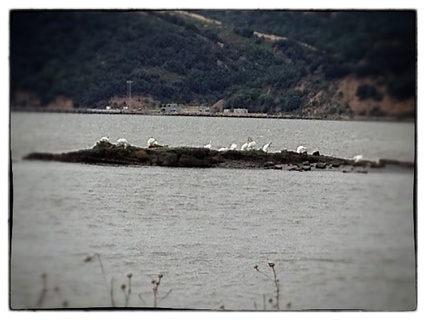
Eyes wide open; I peer through the bedroom window in time to see Canada geese, a trio in flight, noisily bound elsewhere, calling to one another, beaks pointed, necks stretched; chests lifted upward, wings flapping hard. I track their flight over Southampton Bay, the cove on Benicia’s west end. The pale gray clouds of the marine layer blanket the opposite shore of the Carquinez Strait. This wide watery ribbon funnels fully half of California’s water drainage through a deep channel on its way to the Pacific Ocean.   

Cuddling under a soft, embroidered, cotton quilt, while I marvel at the waterfowl, Franz Kafka’s translated words come to mind.  

You do not need to leave your room.

Remain sitting at your table and listen.

Do not even listen, simply wait, be quiet, and solitary.

The world will freely offer itself to you to be unmasked, 

it has no choice, it will roll in ecstasy at your feet.

The universe blesses Benicia with a significant year-round presence of waterfowl—mallards, coots, the great blue heron, and snowy egret. Spring brings an upswing in activity: nesting and the annual migration of some birds to points north. 

by Richard Rossner

Where can we find holiness?

Sometimes I feel like I am in a grand hide-and-seek game with the Creator.  Just when I think I’ve found the deepest of the deep, He escapes me.  Just when I’ve found the perfect light, the right sound, the special spot for a spiritual experience, a hiccup or sneeze ruins the instant.

Then again, moments in life occasionally arrange themselves to create spontaneous experiences that become life-long memories with deep teachings that touch the soul.  They sneak up on you like the first warm smell of Spring that subtly tickles your nose.  You have to stop to make sure they really happened.  To miss these moments would be to miss the juiciest slices of life.

In 1994, I had just moved from Los Angeles to Scottsdale, Arizona.  The Northridge earthquake shook up more than the foundations of my West L.A. town home.  I was shaken to my very core.  I wanted out.  I had been blinded by too much show biz (I had been a writer on a hit show), too much disappointment (I was off the hit show and didn’t bag another staff position), and I was finally tiring of too much life in and out of the Hollywood fishbowl.

Thailand is renowned for having some of the world’s best prostitutes.

It also has some of the scariest.

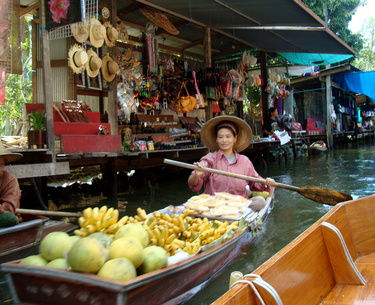
My first order of business upon arriving in Bangkok was an early morning trek to the Damnernsaduak Floating Market, a 90 minute drive south of town in light traffic, and one of the most fascinating places I’ve ever been. 

The Damnernsaduak Floating Market is a series of canals lined by rickety wooden stalls selling all manner of goods, from tacky tourist items to local art and sculptures. You can purchase exotic spices and oils, native clothing, a vast array of fresh fruits, and even play with snakes.

When you arrive at Damnernsaduak you hire one of the long-tailed wooden boats to guide you through the markets. A 2-hour tour is around 300 Bhat (about $9), and the boatman will just float along past shops til one peaks your interest and you ask him to pull up alongside. There are also numerous merchants in other boats selling fresh fruits, meats, or cool drinks. They’ll pull up beside your boat to pour you hot tea, show off their fruits, or describe (always in a language I don’t understand) what their meat on the stick is and why you must buy it.

In the middle of the market is a non-descript shack that at first glance appears to be selling nothing. There are a couple of guys lounging in chairs enjoying a smoke. Upon closer inspection you discover that the men are draped in huge snakes, and are all too eager to show them off to interested tourists.

I can’t resist bad decisions like this, so of course I stopped.

In Wales, Nothing is Quite What it Seems

by Elyn Aviva

We were savoring our after-dinner espressos at Llys Meddyg, a “restaurant with rooms,” in Newport, Pembrokeshire, Wales, when my cell phone rang. I looked at it suspiciously.

During the week we had stayed at Llys Meddyg the cell phone had never functioned inside the hotel. There simply wasn’t any signal. To make a phone call, I had to walk down the street waving it in the air until gradually the bars started showing up.

The phone kept ringing. I answered it and heard a woman’s voice, speaking rapidly. “Hi, this is Winifred. I hear you’re going to write about my land. If you write about my land, you’d better get it right!”

“Hello,” I replied. “How’d you hear about us?”

“My friend David told me. When can we meet?”

The phone suddenly cut out. I ran outside the restaurant and down the street, looking for a signal. One bar, two bars, three. I tried to return the call. It rang once and Winifred answered.

“Sorry, we lost the connection.” I said.

“It’s because of all the volcanic rock in the Preselis. It interferes with cell phone transmissions.”

“So that’s why!” I exclaimed. “I wondered.”

The Primeval Waters of Bahia de Ascension

On the first trip I made with my family to the Yucatan in 1973, tourism was virtually unknown. It was prior to the building of the Cancun airport and the only people who ventured down to this part of the world used cars or trucks on the little-traveled roads. Those existing roads were rarely paved once you got off the main two-lane highway.

by Fyllis Hockman

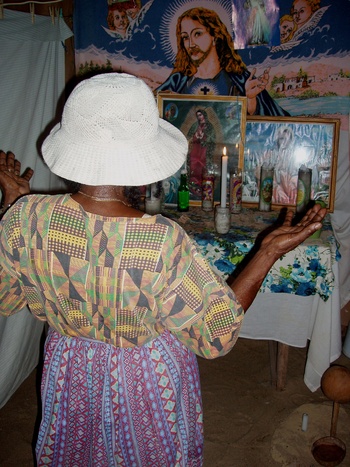
Garifuna healer, Erdangela Polonio. Buyei, Belize. Picture this. The large thatched-roof, sand-carpeted temple was barren except for the obviously ill child curled up in the single cot by the wall. An old woman could be heard chanting from within her sacred chamber, candlelight flickering around the corners of the sheet separating her from the long hall. Her healing incantations, I later discovered, were addressed to the spirits who may have had reasons of their own to inflict the child.

Intrigued? Okay, here’s the story. Spirits are big in the Garifuna community of Belize -- which by the way is a Central American country that thinks it’s a Caribbean island.  Garifuna, you say? Never heard of them. Part of the melting pot civilization which comprises Belize, the Garifuna share the land with Creole, Mayan, Spanish, Mennonite, Chinese and other neighbors but their language, customs, foods and religion are unique. So are their spirits.

Now there are only about 7000 Garifuna currently in the country, but the spiritual population is a lot larger. “Our ancestors are all about us,” Lawrence, our guide, told me: “Just as we must eat and drink to live, so must they be nourished as well.” This is something the ancestors take very seriously.

So if they perceive they are being neglected, the dead return, most often through dreams, to remind the living that they are in need of nourishment. If this message goes unheeded, the spirits may get angry and make a family member sick. The ancestors do not take kindly to being ignored.

Returning to Leyte Landing, For the First Time

by B.J. Stolbov


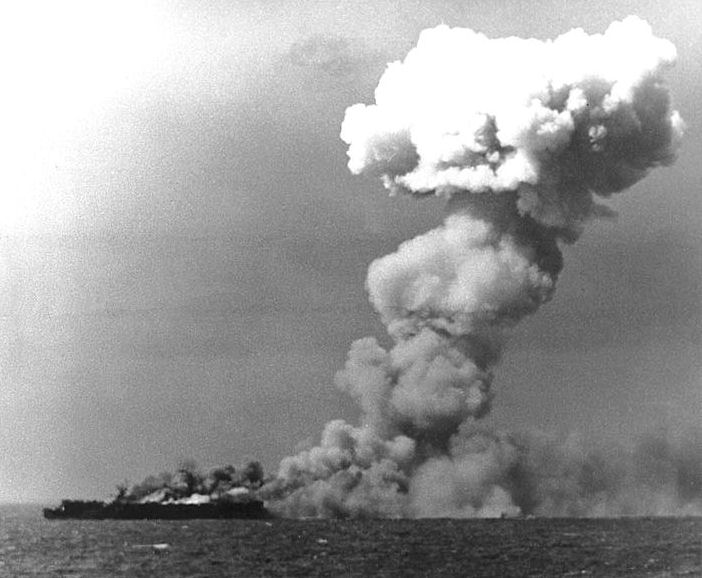
Battle of Leyte Gulf, USS Princeton via Wikipedia commons.If you were to go across the Pacific Ocean by ship to the southern Philippines, Leyte would be the one of the first places that you could land.  In October 1944, General Douglas MacArthur and the U.S. Army knew that, the Imperial Japanese Army and General Tomoyuki Yamashita knew that, and Captain Morton S. Stolbov, D.D.S., a U.S. Army Field Surgeon, also knew that.

Leyte Gulf is the biggest gulf in the southern Philippines that opens into the Pacific Ocean. Ships, hundreds of ships steamed in, then turned north into San Pedro Bay, then turned west, toward the town of Palo, then finally turned onto a long expanse of beach that the U.S. Army called Red Beach. Here, on October 20, 1944, the largest landing in the Pacific Theater took place.

One of the first to come ashore that morning was Captain Morton S. Stolbov. He didn’t have to be there. He didn’t have to go to war. He had graduated from Temple University Dental School in Philadelphia, Pennsylvania, in 1939. He returned to his parents and his home, Tamaqua, Pennsylvania, a small town in the coal regions, and opened a dental practice. He was doing well in his hometown, his career, and his life. A short man with thick glasses and a receding hairline, he was already 27 years old, too old to be drafted, when the Japanese attacked Pearl Harbor on December 7, 1941. But, in one of the few spontaneous acts of his life, he volunteered to go to war.

Honoring America's Fallen Soldiers in Normandy

by Roy Stevenson


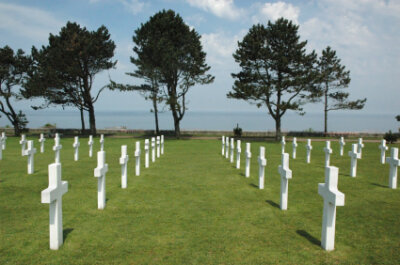
American Military Cemetery, Colleville, Normandy, FranceThe view from the top of the high, soft, sand dunes next to the American Military Cemetery at Colleville, Normandy, is great today. It’s a bright clear blue sky and I can see for miles. French fishing trawlers churn through the choppy, deep blue water, miles out to sea, leaving wide foaming wakes behind them. Gazing down across the long, deserted flat white expanse of Omaha Beach, I can see where the olive uniformed American soldiers debarked their landing craft, to shelter behind steel tetrahedrons, or sprint up the beach on D-Day, June 6, 1944.

Descending the sand dunes, I walk the long 500 meters down the gently sloping beach to the water’s edge. It’s dead low tide. I turn around, looking back up towards the dunes. I’m amazed at how far away they are. They would seem like they were miles away, especially to a young soldier armed to the teeth and heavily weighed down with equipment.

It must have been terrifying trying to sprint up the beach into the teeth of a hailstorm of machine gun, rifle, and mortar fire. Of the soldiers in the first few D-Day landing craft, 90% didn’t even make it up the beach. In my mind’s eye I fleetingly see chaos, patches of red blood-drenched sand, and a flickering image of a young soldier in a soaked green uniform. “I must have seen “Saving Private Ryan” once too many times”, I think self-consciously.

Deep in thought, I trudge back up the steep, uneven sand dunes to the American Military Cemetery and walk along row upon row of perfectly aligned white crosses, on the vast 172-acre, smooth, emerald green-grassed plateau. The 9,387 crosses are a stupefying sight. They radiate outwards in perfectly straight lines no matter what angle they are viewed from.

by Maureen Elizabeth Magee


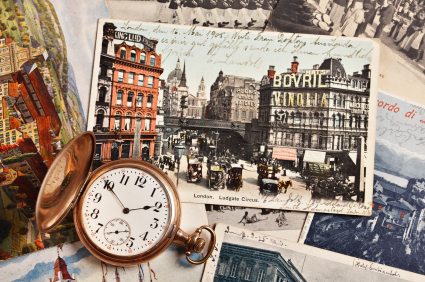
I adore postcards. But I can’t remember the last time I received one – can you? Probably sometime around the mid-1990’s, just before email sucked the life out of stamps.

It seems that, while I wasn’t looking, sending postcards went out of style. Well, let’s face it – everything does, eventually. But it hit home this past holiday season, when assorted friends took off for Australia, New Zealand, Guatemala, Spain and Dubai – and the mailman never delivered a single card to me.

Am I the only one who loved to send them? Most people are quite happy to receive one in the mail, but a particular joy of mine while traveling has always been to spin those metal racks in the tourist shop and study various options in order to find the perfect photograph for each individual on my list. (Mount Fuji for the climbing buddy, Kyoto cherry blossoms for my gardening pal, the Uwa Jima Pornography Museum for….well, never mind.)  I would send postcards to everyone; friends, co-workers and neighbors.  Including some folks I would never consider writing to otherwise, but now wished to impress with my fabulous life exploring exotic places, while they never got farther than their mailboxes.

Turning Japanese

by Jennifer Morton


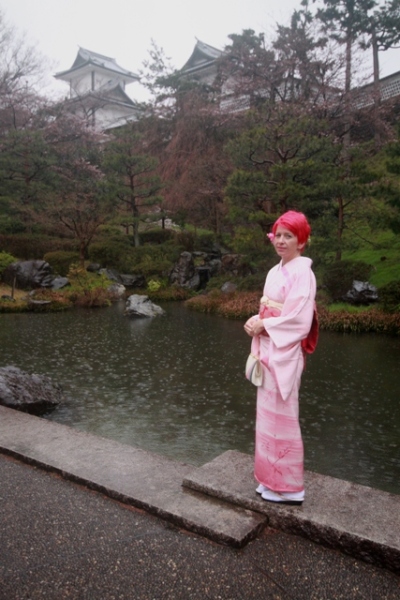
“No photos with coat,” she instructs my photographer husband with a smile. The petit, pigeon toed, doll-like figure clad in a silky red, black and white kimono is ever so polite but adamant about him not taking any photos of me while I am wearing the box-shaped overcoat.

Photos in the kimono are allowed and encouraged but almost forbidden if the kimono-clad woman is wearing an overcoat. I bow slightly and smile while nodding affirmatively. I feel and look like a modern version of an obedient Japanese woman.

It’s my 40th birthday and I’m about to hit the streets of Kanazawa, the small castle city on Japan’s main island of Honshu that is northwest of Osaka. I am a bit nervous to be going out amongst the Japanese people: a Westerner with pink hair wearing the beloved kimono.

So you probably want to know what I am doing in the kimono under an overcoat in Japan, and who says I can't be photographed in an overcoat. Actually, it started two hours ago. When I arrive for my one o'clock appointment, I notice the foyer is lined wall to wall with shoes and slippers, like many Japanese households. It is customary to remove footwear and swap your shoes for a pair of slippers before entering.

Haruka, the young owner of the kimono rental shop greets us with many bows and the familiar “Irrashimasse” (welcome), a word that is used by many shopkeepers as you enter their shops or to entice you to enter their shops.

We duck through the noren (door covering), and enter the main sitting area. A low set table with red cushions as seats is in the middle of the room. Pictures of kimono-wearing woman, mostly Japanese, adorn the shelves and table tops.

Haruka shuffles through the paper-panelled sliding doors and disappears up a dark staircase. I follow her, using my hands to climb my way up the steep passageway. The room at the top is bright and airy. This is where the kimonos live.

The shelves are covered with delicate fabrics and laid out in color–coded piles. Haruka points out which ones are for springtime--pastel pinks, soft blues, yellows and purples; some with delicate features or intricate designs lie before me. I’m drawn to the pinks.

I choose a soft, pink silk kimono that gradually darkens as the material reaches the calf area. The fabric is designed with sporadic branches and leaves, similar to sakura (cherry blossom). I feel like a little girl playing dress-up.

by Fyllis Hockman

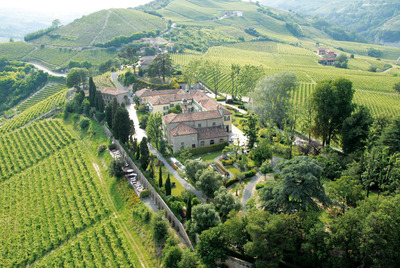
Relais San MaurizioAlright, we all know by now that drinking red wine is supposed to be heart-healthy. So then, shouldn’t slathering a glass of Merlot on your body be good for the skin? Such is the theory, sort of, at the Caudalie Spas. There are currently only four in the world, and I am luxuriating in a ‘vinotherapie’ massage in the Relais San Maurizio Hotel in the heart of the Piedmont region of northwestern Italy. The vintage is being absorbed into the skin rather than ingested into the bloodstream.

As is also true in Bordeaux, France, Rioja, Spain and New York City (Hmmm; don’t exactly think of the latter as a major wine-producing area…), here wine is king! And the appreciation of its many attributes – which, as those who know me can attest, I try to experience as often as I can – is a venerated practice. So it seems appropriate that the consumption of wine extend beyond traditional imbibing.

Searching for Sunrise in a Megalithic Cemetery, Ireland

by Elyn Aviva

Cautiously, my husband Gary, our friend Michael, and I followed a nearly invisible path through the fog and up the side of Loughcrew hill, just before sunrise. A huge crow—perhaps a raven—flew by, its wings flapping loudly in semi-darkness. We were heading to the ridge top to see a twice-a-year spectacle: the rays of the equinox sunrise penetrating the passageway of Cairn T, a 5,500-year-old megalithic tomb situated 52 miles northwest of Dublin. The equinoxes, which occur around March 21 and September 21, are the two times of the year when the days and nights are of equal length.

Running Aground in British Columbia

by Kristine Mietzner


I dropped the bright white main sail, secured the halyard, tied six marine blue nylon ties around the sail’s bright white folds, and finally, stepped back into the cockpit. The sailboat purred as my children, their father, and I approached Oak Bay Marina under engine power. 

A bald eagle soared high above us, a curious raven cawed, flying above the mast, and a gull landed on the bow, checking us out.                                          

Standing in the cockpit of the Sagale on a sun-filled August afternoon, Mark and I prepared to dock near Victoria, British Columbia. In the main salon 14-year-old Anna read Little Women while eight-year-old Ben played with Legos on the cabin floor.
 
Mark looked at the water, met my eyes, and called, “Read the depth meter!”
 
Scanning the red numbers on the black box attached to the cockpit wall, I said, “Thirty feet.” We slowly moved toward the marina.
 
“What does it say now?” Mark asked.
 
“Twenty feet.” A few moments later I called, “Fifteen,” in a more concerned tone. As the depth grew shallower, I shouted, “Thirteen! Mark, it’s not deep enough. Turn around! We’ll hit bottom. Get us in reverse.”
 
“We’re fine,” he replied. “That’s only the distance from the tip of the keel on down.”
 
“Not! It’s the distance from the water line to the bottom? We’re going to hit bottom! See for yourself,” I said.
 
We both looked over the rail and saw the sea floor through the clear, translucent, aqua water. The ginger-colored sand appeared as close as ten feet but it was difficult to be certain with the sunlight refracting through the water. In any case, it was far too late to stop the forward motion of the vessel. I glared at Mark as he repeated, “We’re fine. We’re fine.”
 
He is so wrong! This is so typical and here I am trapped on this boat with him.
by Andrea Campbell

By traveling to find my father's family, I became a bridge between the Soviet Union and the United States. But first, allow me to back up and tell you my story. 

I had been an orphan and spent seven abysmal years in foster homes. When my mother died of cancer, I was only ten. She was 45. It was the worst thing that ever could happen to me, I thought. Unresolved grief walled my heart.  For comfort, I turned to my big sister who was as devastated as I.  And I looked to my distant, hard working, passionate Ukranian immigrant father for a sense of security. Though he tried to fill my loneliness, he suffered from depression.

Two years after my mother died, my father died. I was twelve and alone. Because my sister was separated and planning to divorce, the courts decreed that her’s was a broken home and not a good environment for me.   Thus, I was sent to the first foster home. I lost my mother, my father, my home, most of my belongings and close contact with my sister.  I was isolated and abandoned.  

Somehow, I gathered family photos. As I matured, through hard work (dealing with my own suffering), years of schooling and post-school training, I chose a career in mental health. I found happiness and deep satisfaction as a mother to my daughter.

When my father left Russia in 1915, he was 15 years old.  He never saw his family again.  I was told he kept a goat in a lot on Prince St., Newark, New Jersey.  A noted School of Medicine and Dentistry now stands on that spot.  A letter from his mother in 1939 contained a photo of his nephew, and a request to cease communication.  At that time, having American family was potentially politically dangerous.  The last he heard about them was that they were starving during WWII.  When my father died in 1956, he thought they had starved to death or were killed by Nazis.

by Susan Mckee


After flying into Tel Aviv, Israel, from Amman, Jordan, I went to the transit area of the airport (since I was changing from a Royal Jordanian flight to the El Al flight to Newark).

There was no one in the area, so I picked up the phone and asked for instructions. I was told to wait. Three more passengers from my same Royal Jordanian flight then arrived, plus two airport workers, one in a suit and both with mobile phones. The workers told us to sit and wait for our luggage. One kept repeating the numbers from our baggage tags into his mobile phone. 

After more than a half hour, the bags for the three other passengers arrived, but mine did not. The workers said that my bag was not on the baggage carousel with the other luggage from the flight. I asked to leave and go through passport control to check with the Royal Jordanian staff about my luggage. I was told to sit down and wait where I was.

More people arrived (no one was introduced), including a series of security officials who questioned me about my travel. Why was I in Israel? (The Freelance Council of the Society of American Travel Writers was invited to come.) If I was a guest of the Israeli tourism officials, with whom had I met? (The names were all on the papers in my missing suitcase.) Why would Israeli tourism host me? (You’d have to ask them.) What people had I met in Jordan? (The usual tourism industry folks.) Did I have any relatives there (no), and on and on and on.