Saudi Arabia: In the Glow of Aladdin's Lamp
It was a strange dream for a small girl: To join the French Foreign Legion in Algeria. Yet the idea of having adventures in a vast desert sounded magical to me. I admired the grit it took to be a Legionnaire and envied their daring forays into a desert world unknown to Westerners. All things about the desert fascinated me. I embraced images of sand dunes, camel caravans, oases, goat-hair tents, and the famed Arabian hospitality within them. Characters linked to the Arabian desert also captivated me: the almost-mythical Lawrence of Arabia, leader of the Arab revolt; the daring Victorian explorer and archaeologist Gertrude Bell; and, of course, Aladdin and his amazing lamp.
When an already-planned flight to Egypt included the possibility of a stop in Jeddah, Saudi Arabia, I jumped at the chance to finally visit the Saudi Arabian desert for myself. Fortunately, my husband Terry also found the possibility interesting, though some people raised eyebrows when we told them of our plan. “Saudi Arabia? Isn’t the Kingdom notorious for human rights abuses?” I’d counter that we had an enormous problem in our own country with human rights abuses, didn’t we? Maybe opening up the Kingdom to foreign eyes might encourage some internal self-questioning. I noted that Saudi Arabia had only been open to tourism since late 2019. We would be among the first American tourists to get a glimpse of this often-maligned country.
Once in Saudi Arabia, we spent a few interesting days in Jeddah and then headed out to the desert, specifically to an area called Al Ula. The region is not just a dot on the map; it covers about 8,500 square miles, larger even than the country of Belgium. The Saudi government is at work promoting it as a desirable destination for tourists. I prayed that it was not becoming a Disneyland version of the Arabia of my dreams.
Though Lawrence of Arabia came to Al Ula to fight Turkish troops and blow up railway trains, my experience would be quite different, of course. The only thing I would be shooting would be photos. I would not be riding on the back of a camel or sleeping under the stars. Instead, I’d be exploring the area in a rental car and testing out one of the few places to stay, a new desert resort.
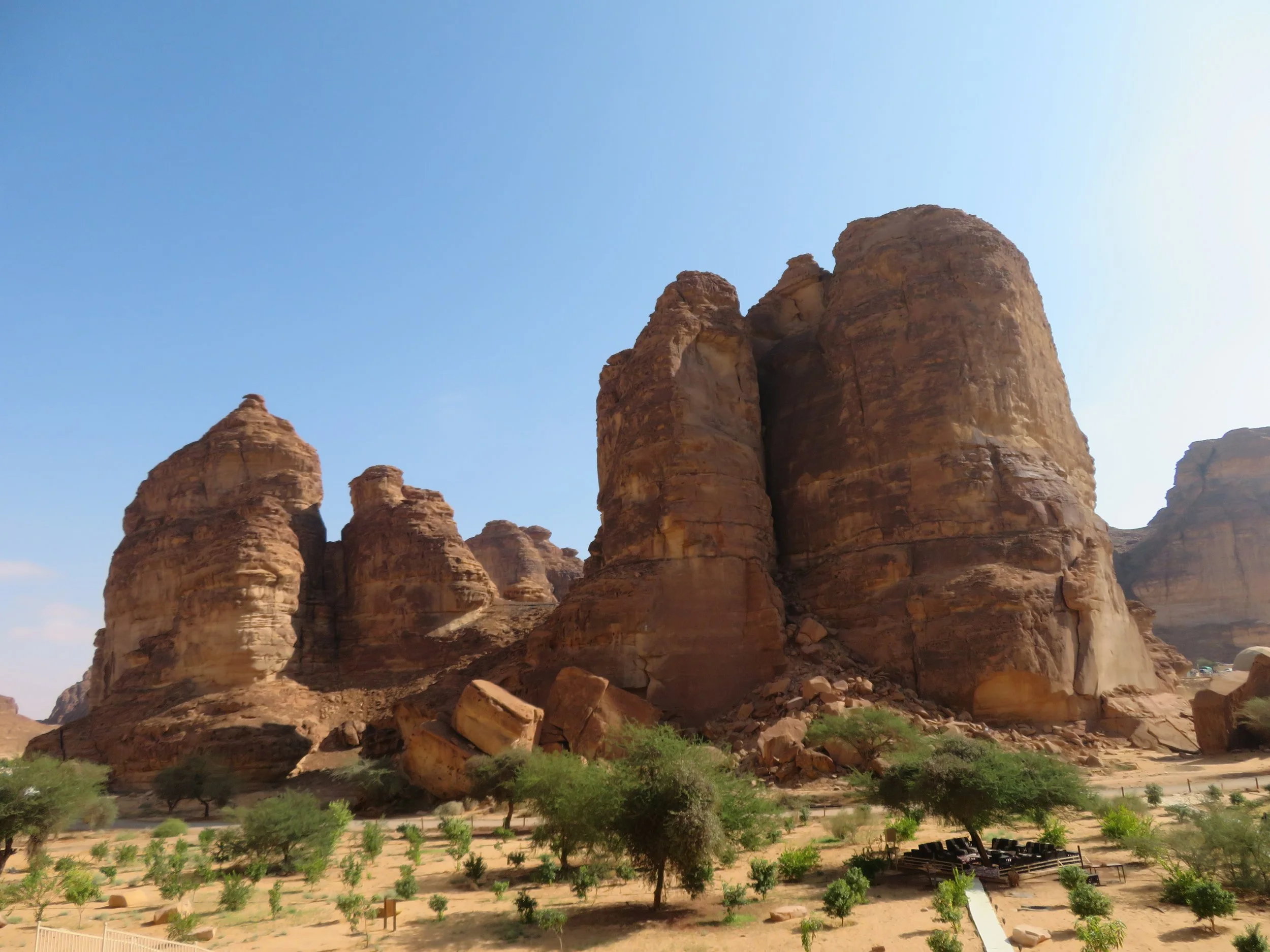
Al Ula is just a short flight from Jeddah, and an employee from our resort picked us up at the airport. At first the landscape we passed through was just a flat sandy desert, dotted every so often with enormous cranes and dusty construction sites. But then we passed through groves of lush green date palms and glimpsed an occasional mudbrick residence, and, most impressive of all, towering rock formations sculpted in surreal shapes – much like the photos taken by Gertrude Bell herself!
Our driver turned off the paved road onto a dirt track and dropped us off at reception of the Shaden Resort, a sprawling property that even contains its own organic farm. We were welcomed with the traditional offering of Arabian hospitality, coffee and dates, and soon whisked off in a golf cart to our room. It was located along a row of self-standing, drab-looking buildings, and our room was quite Spartan. But when we pulled open the curtains, I let out a big “Wow!” We were in the center of a ring of towering rocks set into a sandy wadi, or river valley, with an inviting sitting area right outside our sliding glass door. Who would miss fancy wall art with a view like this? Now I could enjoy a real piece of the desert for myself.
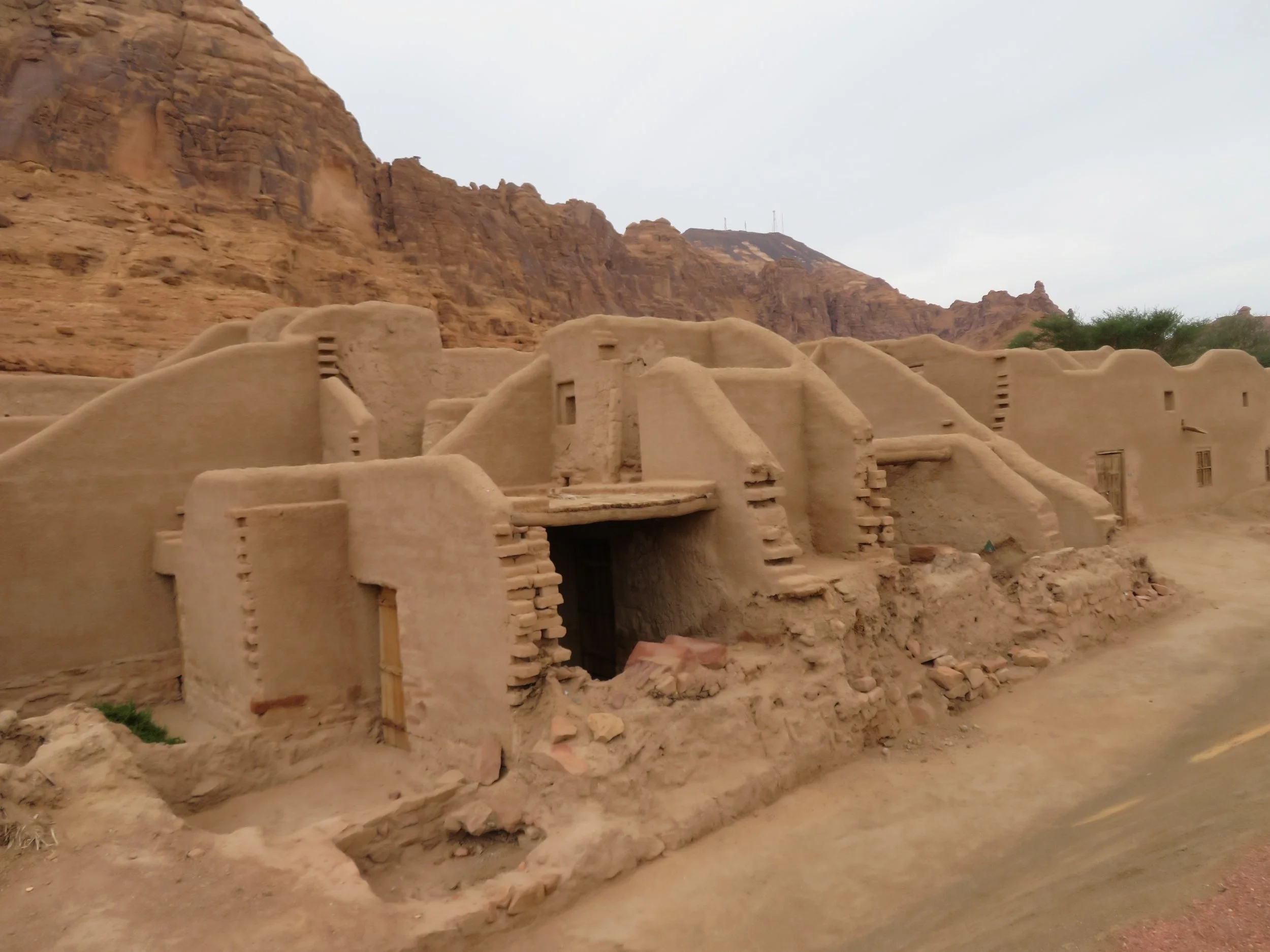
We would only be able to spend a few days in Al Ula, and there were more interesting things to see than time to see them. We had to be careful in our choices. We decided to spend our first day exploring the ancient town of Al Ula, now uninhabited, and its adjacent oasis. There’ve been permanent settlements in the oasis since 5000 BCE, and the town of Al Ula had once been a welcome stop on the old caravan route for precious frankincense and myrrh. At one time it was the capital of an ancient civilization, the Dedanites, who are mentioned in the Bible, and then the home of the Nabateans, the same culture that carved the stunning tombs in Petra, Jordan, but Al Ula was deserted by the 1980s.
The Al Ula we were visiting, however, was not just an empty, walled city of collapsed mudbrick houses. It contained a bustling thoroughfare of restored buildings that housed an inviting collection of little shops and cafés. Off the main path, we were able to wander down the city’s narrow, twisting lanes and enter its little plazas. I could easily imagine what living here would be like, packed in with your neighbors, buying fresh vegetables in a nearby shop and socializing in one of the plazas. And it was not difficult to picture El-Aurens, as the locals called the great Lawrence, stopping by to purchase some dates and coffee beans, which he well might have done, since it was still occupied during his time there.
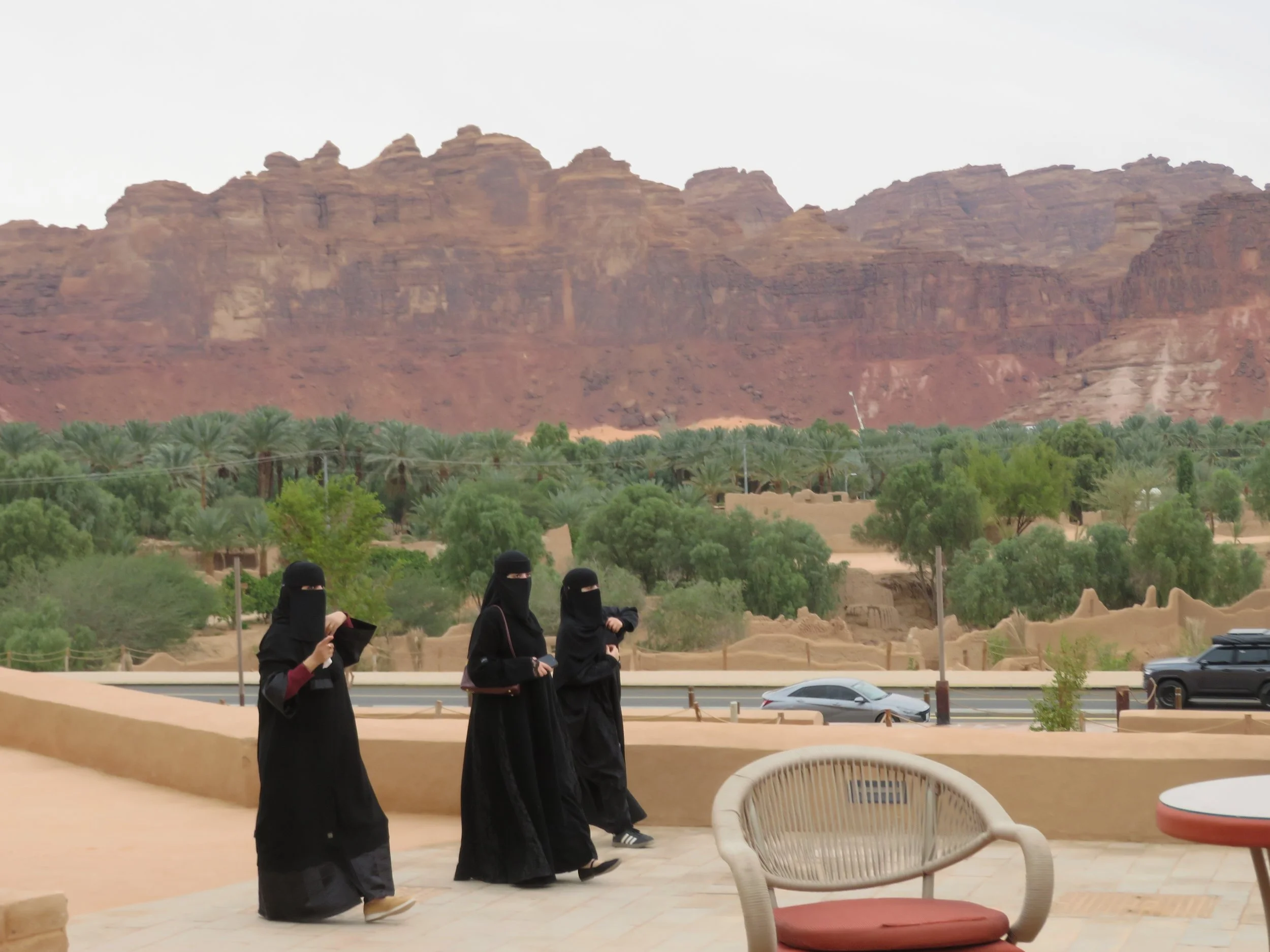
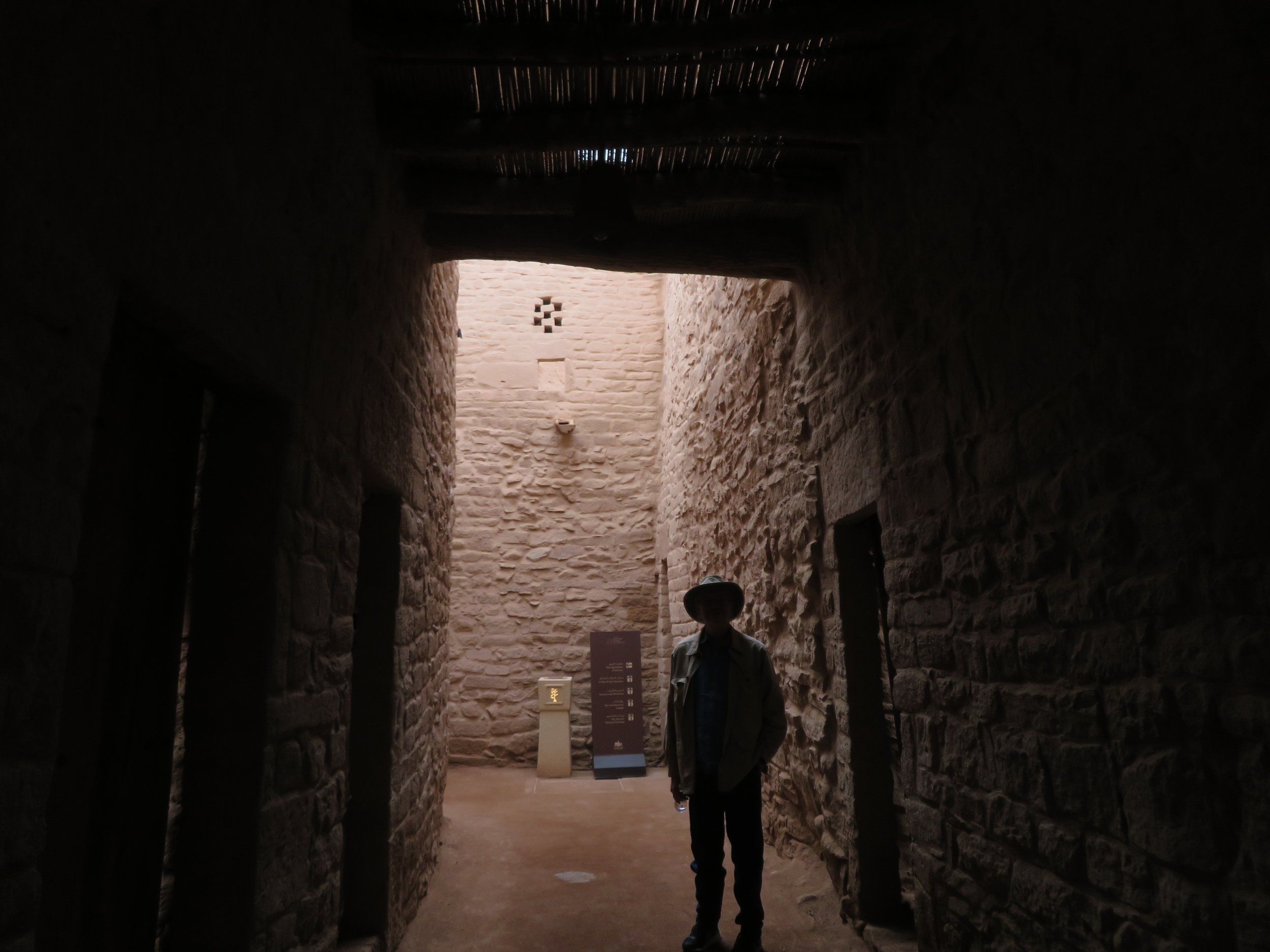
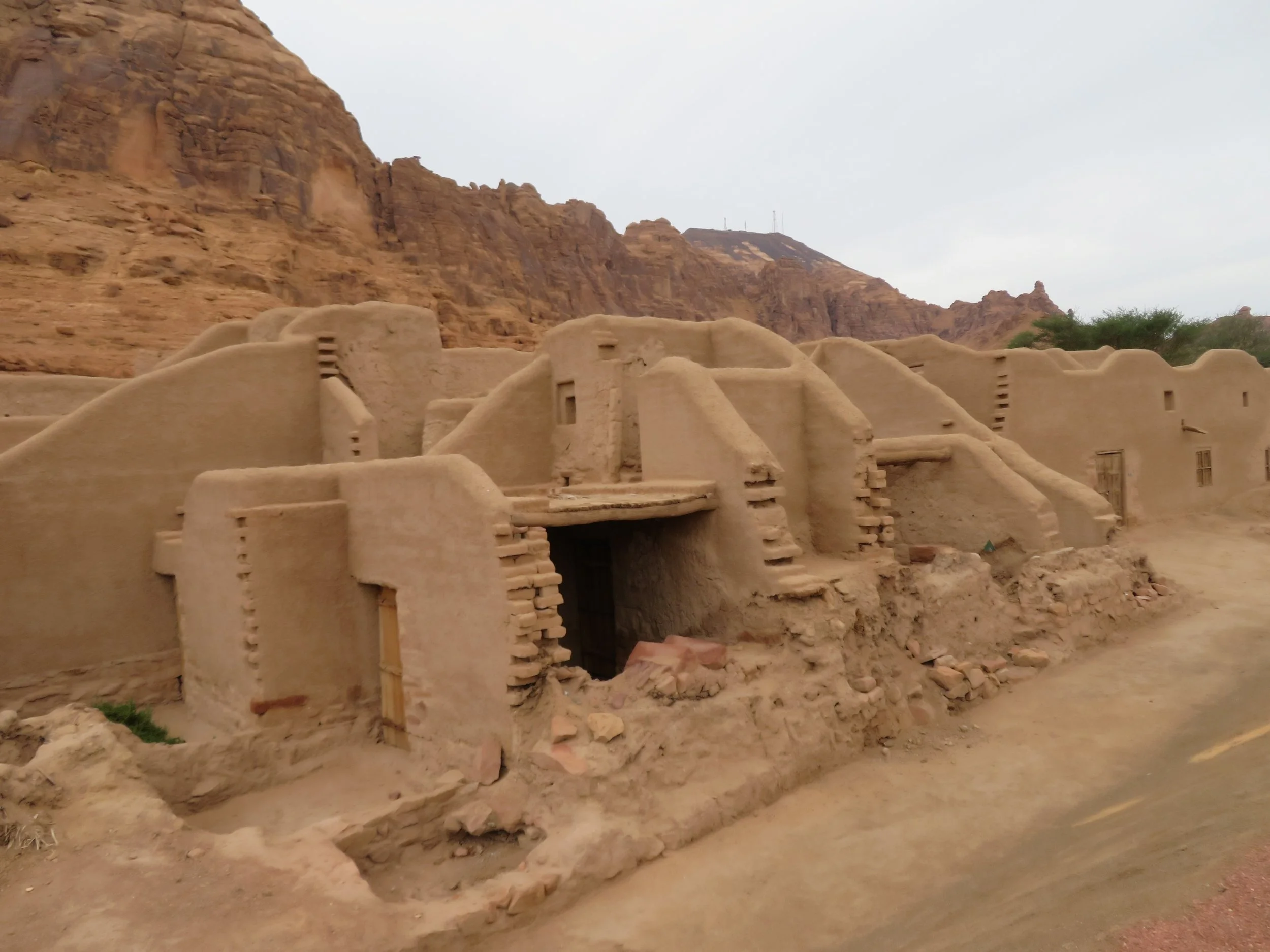
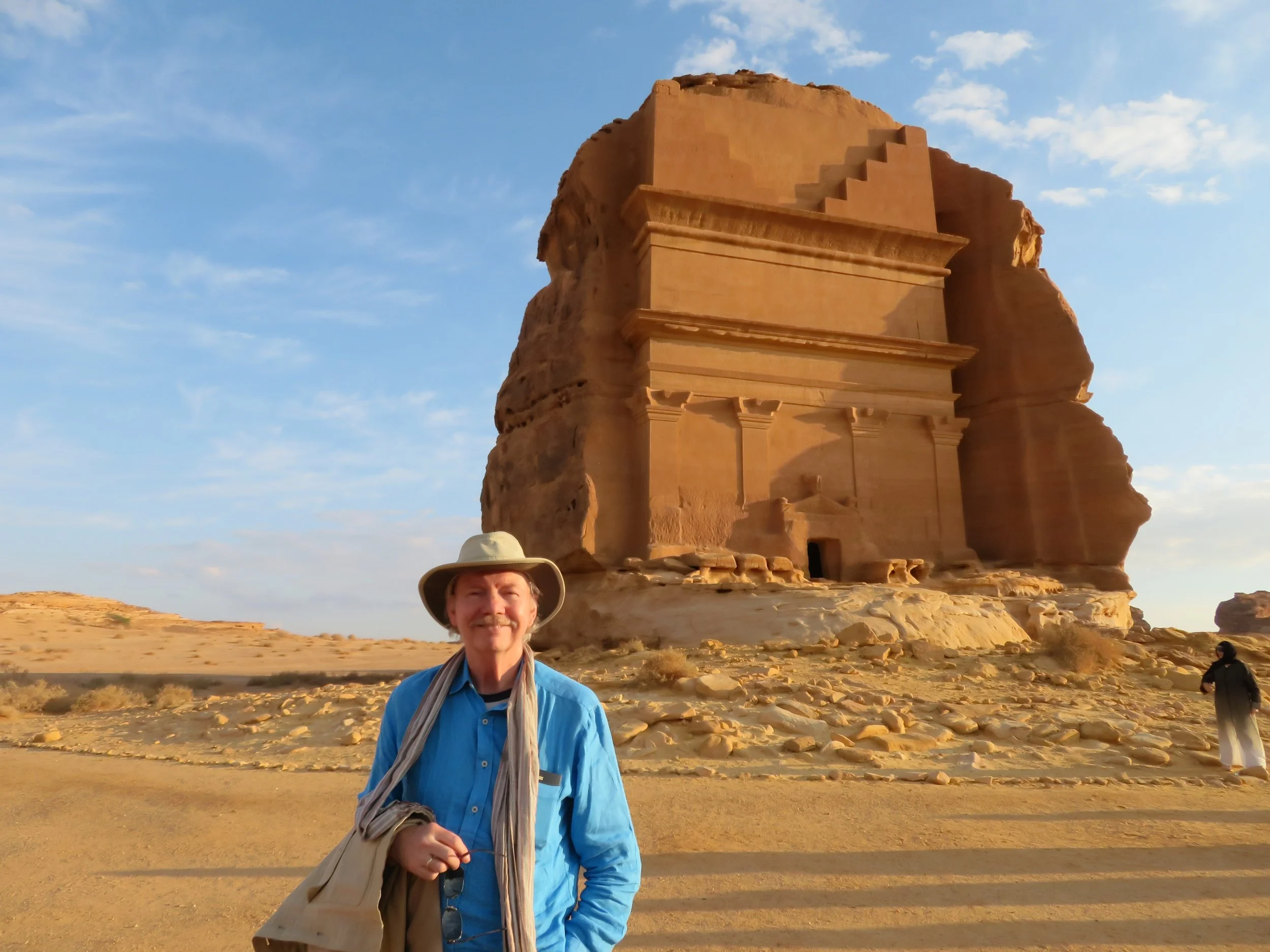
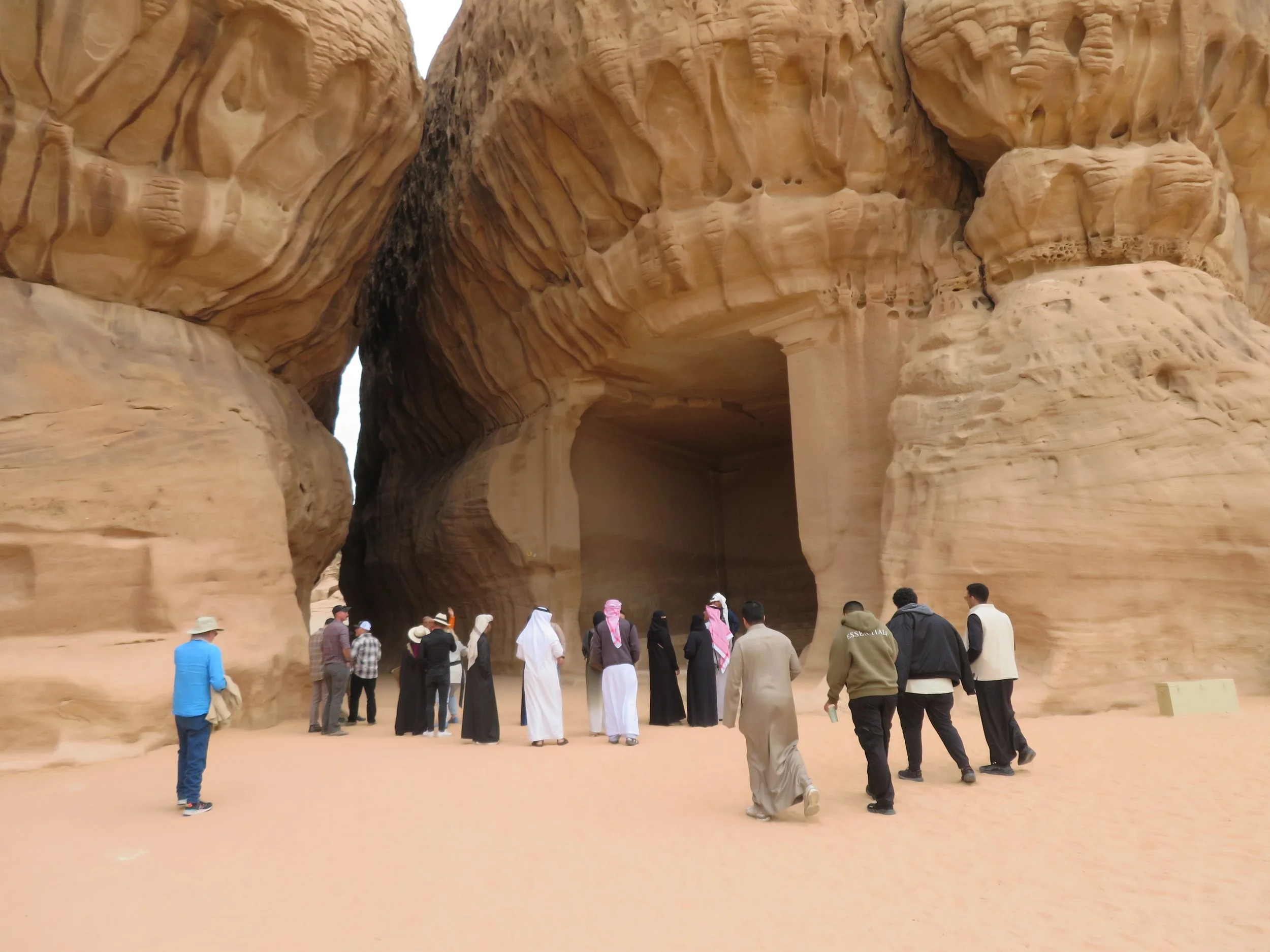
After exploring the old town, we enjoyed dinner at an outdoor café under cloudy skies. Unfortunately, the same cloudy skies meant that my eagerly anticipated adventure deep into the desert, to Gharameel, for star-gazing and a traditional Bedouin dinner, would be cancelled.
I had hoped the excursion would offer me an undiluted desert experience, but at least our trip to Hegra the next day would let me get another piece of the desert. Hegra is the place where the ancient Nabataeans once dwelt, and where their elite were laid to rest in magnificently carved sandstone tombs. The Saudi government has restricted access to Hegra to organized bus tours. Despite this restriction, we were able to wander around freely at the four sites and admire these impressive works of sculpture. They loomed strangely out of the otherwise barren desert, where no other trace of the Nabatean civilization remains.
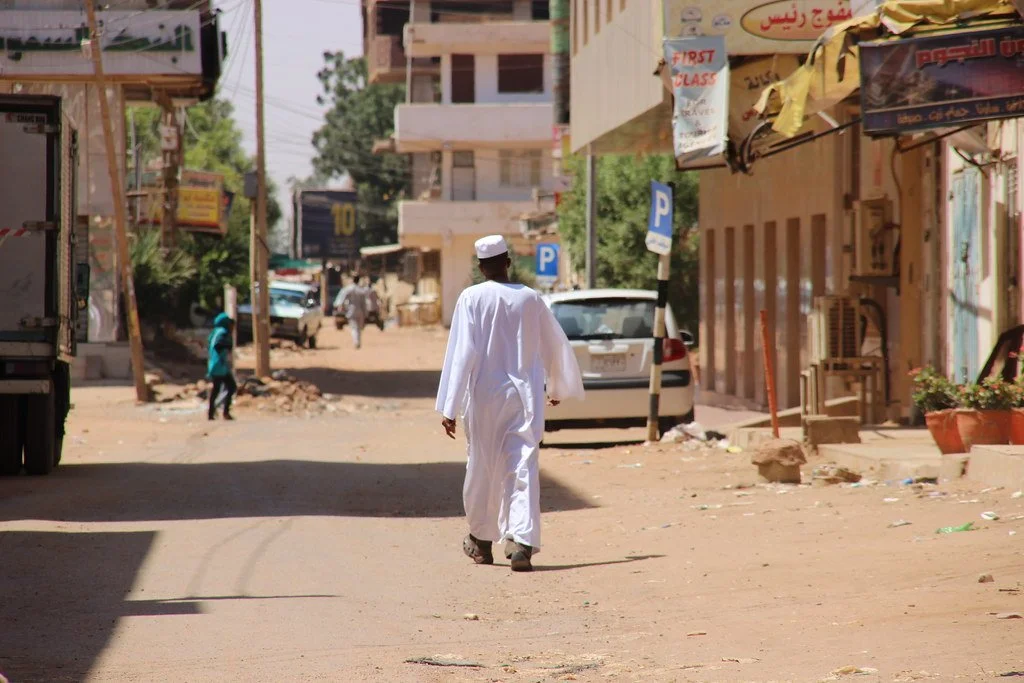
The ride back to the resort gave me some fleeting glimpses of the desert I’d hoped to see: the sunset softly illuminating the towering rocks and the vibrant green palm groves beneath them… a man in a long white thawb walking along a dark pathway towards a white mosque… and a rider in a dark cloak galloping full tilt over the sand on a magnificent white Arabian horse. No question: These hauntingly beautiful images could have been illuminated by Aladdin’s lamp.
Carolyn Handler Miller (www.carolynhandlermiller.com) is a writer who works across a variety of media. Originally beginning her career as a newspaper reporter and magazine journalist, Carolyn's projects span TV shows and specials, feature films, books and new media. She is one of the pioneering writers in the field of interactive narrative, where she has contributed to over 50 projects as a writer, writer-story designer, and consultant. She is the author of “Digital Storytelling: A Creator's Guide to Interactive Entertainment” (Focal Press), now in its fourth edition.