Seeking the real nirvana in the Big Dark
Didn't go for a walk.
The dogs didn't either.
No Pilates. No weights.
Didn't even stretch.
No sit-ups.
No yoga.
No supper.
Last Sunday was a lost day in the midst of the Big Dark, the name for this time of year in the north, and you know what?
It's OK.
Rain was sluicing down.
A steady southeast bluster brought temperatures that varied from 44 to… 46.
Water drops slapped the windows like locusts.
A rumor of light behind seventeen cloud layers was like a candle in a house of ghosts on a distant hill. Maybe the moon, maybe the sun, maybe aliens squandering cold fusion nuclear power.
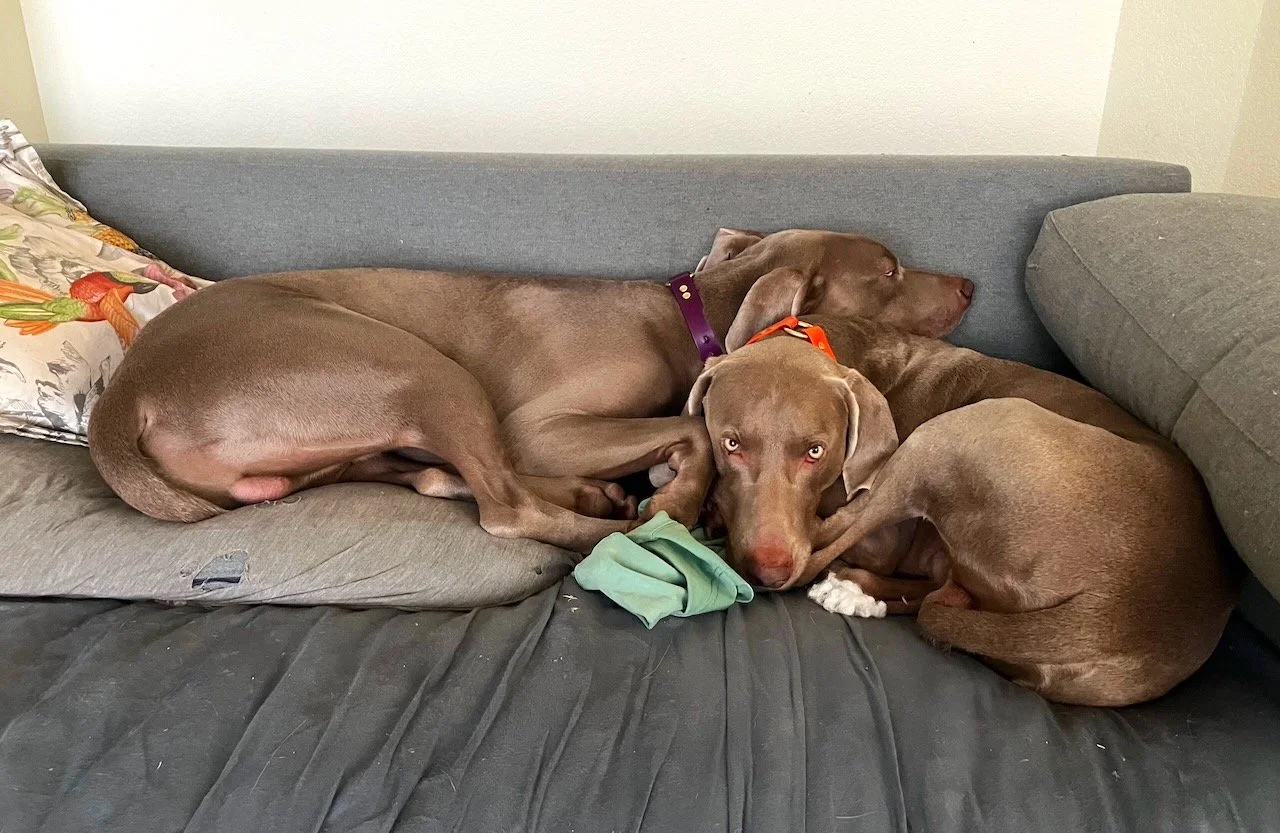
We are of North European extraction, Nicole and I. So are our dogs, Weimaraners; and our Shetland pony and Polish Warmblood. Not only do we all genetically recognize this kind of weather in this time of year, we know what to do.
The dogs, Simon and Blue, dashed outside to do their business as hastily as New Yorkers crossing against traffic, returning post haste to make sure the couch was still comfy. The horses headed out to grump around in the lee of the trees, then trotted back to the barn. The fireplace manager brought in wood by tiptoeing along the back of the garage where there is wind-and-rain shelter.
We both disappeared into digital nirvana, Eric watching football and Nicole old martial arts movies. Yes, that does happen here at our progressive, holistic, spiritually grounded natural wellness farm. It's useful to reflect on what 'nirvana' means. It's not bliss, the metaphysically hilarious mistake that most people make about that term. Nirvana is a transcendent state opposite bliss in which there is no suffering, desire or sense of self. You could hardly find a better description for a gray day spent watching football and Bruce Lee.
No progress is made. No retreat, either.
One of us might lie in a hot bath reading an immense, tiresome potboiler about human consciousness. The other may sit in the embrace of a molecular enhancer, studying the Aleph-Tev numbering system.
Or we might just watch the deer in the meadow below. Deer don't move fast, so there's plenty of time for this, which means we can ruminate on the works of the great philosophers, such as:
• The only reason for time to exist is so everything doesn't happen all at once (Einstein)
• Time you enjoy wasting is not wasted time (Marthe Troly-Curtin)
• Never put off till tomorrow what may be done the day after tomorrow just as well (Mark Twain)
Again, all this is OK. Not every day, but for periodic episodes in the depths of the Big Dark, the time of year when our forebears long ago huddled around the fire in the cave or longhouse sharing ancestral stories, chants and myths, passing these on to the next generation and on down through the languid fogs of time.
Once years ago I was slumping along the road trying to achieve a January "energy walk" when I bumped into a wise neighbor who asked how I was. No ambition, I replied. Doing nothing. Lackadaisical. Indolent. Sludgy. Feeling guilty.
"But that's how you should feel this time of year!" she exclaimed. "Except guilty. Just don't go to bed and stay there until spring."
Modern people are wont to call these "mental health days," as if it's necessary to explain the failure to make a million dollars or write a book or exercise five hours or bake Black Forest cake for a midday snack. Blame our Puritan forebears. Don't blame Native peoples—they all knew what to do: Keep the fire going and hang out until the daffodils bloom.
There was no cooking that Sunday. No money was made. No books written.
No exercise.
All perfectly, wonderfully fine.
Lifelong journalist and editor Eric Lucas lives on a small farm on an island north of Seattle, where he grows organic hay, garlic, apples, corn and beans.