What I didn’t Know About Thomas Jefferson
The manager of the Villa Diner approached my table with a conspiratorial smile.
"Today's your lucky day," he whispered. "Someone has paid for your breakfast."
I looked up in disbelief. "What?"
"It's been happening all morning."
When I asked if I could thank my anonymous benefactor, he told me they wanted no recognition, just the satisfaction of brightening a stranger's day. I couldn't have asked for a warmer welcome. The gesture also left me wondering what, exactly, Charlottesville had in store.
My first stop was the University of Virginia (UVA), designed by Thomas Jefferson. The campus felt like a beautifully composed work of art. Graceful colonnades invited me forward, each building subtly different from the next. Then I saw the magnificent Rotunda at the end of the lawn. Modeled after Rome's Pantheon, it anchors the campus. What struck me most was that, instead of placing a chapel at the heart of the university, Jefferson chose a library.
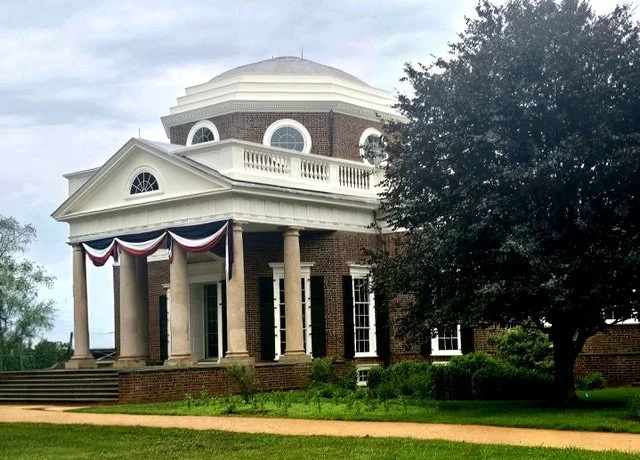
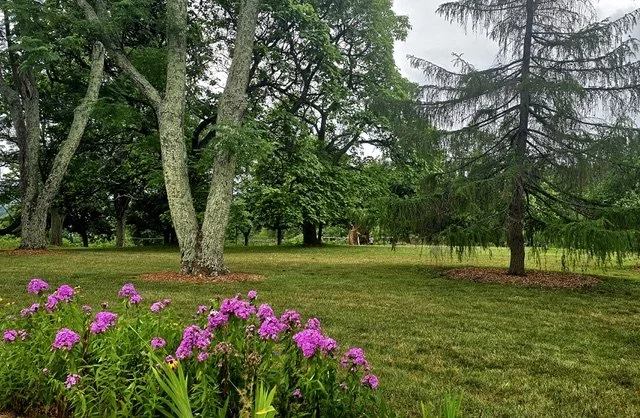
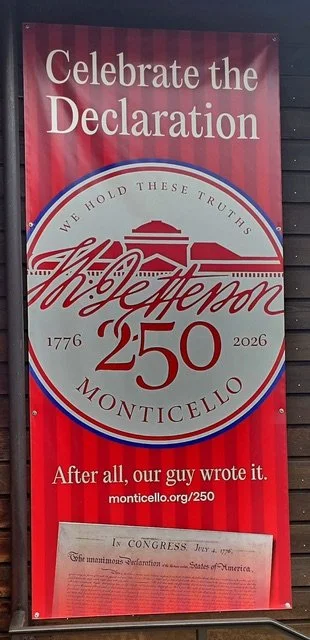
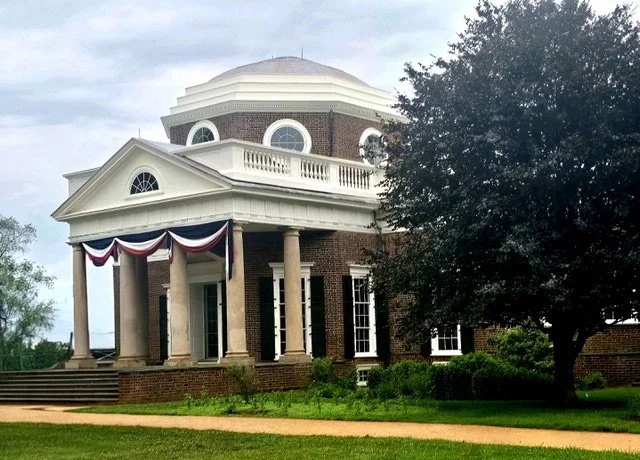
The destination that had prompted my visit to Charlottesville was Monticello, Thomas Jefferson’s home.
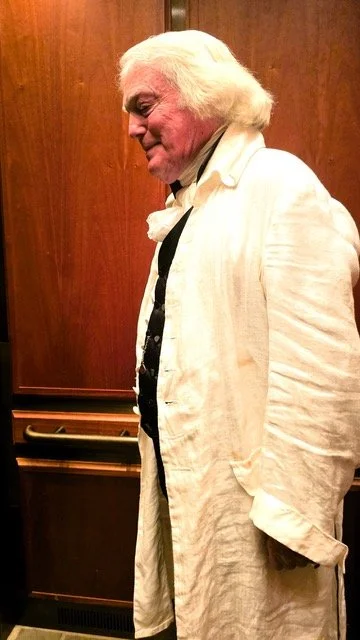
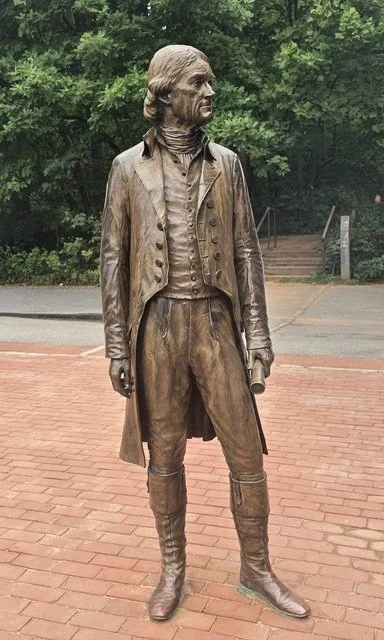
As I walked to the visitor center, I found myself sharing an elevator with Mr. Jefferson, or at least a convincing historical interpreter portraying him.
I laughed when I saw him. "It's a pleasure," I said, "and a little odd to meet you in an elevator."
Without missing a beat, he replied, "I'm all for labor-saving devices. I only wish I'd invented it."
“May I take a photo? I asked.
He agreed, then commented, “Now that’s something I really wish I’d invented!”
The exchange lasted only a minute, but it captured Jefferson's reputation as an inventor and relentless tinkerer.
Like many Americans, I arrived knowing key facts about Jefferson: principal author of the Declaration of Independence, governor of Virginia, president, ambassador to France, founder of the University of Virginia. I also knew the painful contradiction of a man who spoke eloquently about liberty while enslaving hundreds of people. The tour guide explained that Jefferson understood the contradiction, but believed future generations would need to solve the problem.
This seemed paradoxical to Jefferson’s relentless pursuit of what he believed was just. How could the man who wrote and ushered into law the Virginia Statute for Religious Freedom be so passive about slavery? Walking through Monticello, I kept coming back to that contradiction. I’d hoped to see the slave quarters and Jefferson’s mistress Sally Hemings cottage. But I have mobility issues and that wasn’t possible. Seeing them might have helped me to better understand Jefferson’s position on slavery.
In contrast, another aspect of Jefferson that I hadn’t fully appreciated was the breadth of his curiosity.
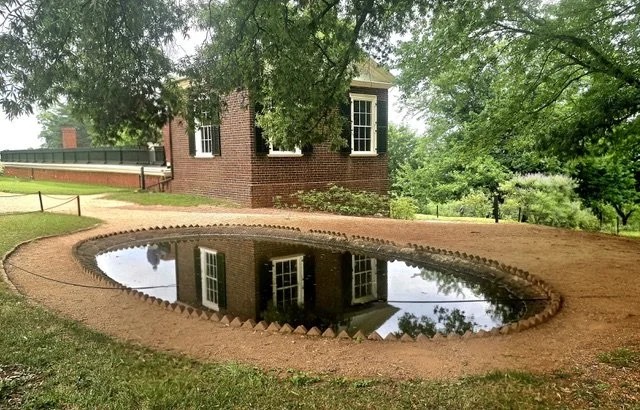
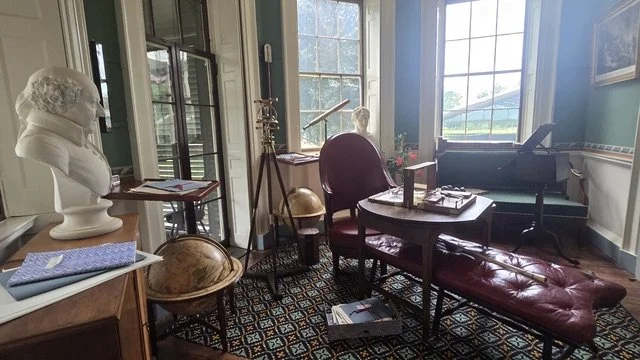
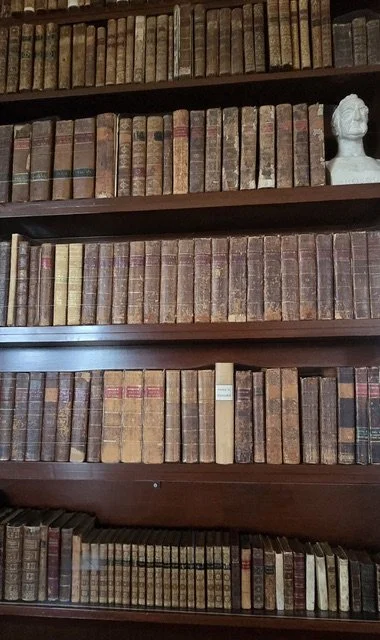
Monticello isn't just a historic house. It's a laboratory of ideas. Jefferson constantly redesigned rooms, invented gadgets to make daily life more efficient, and filled the house with books, maps, scientific instruments, and ingenious devices. One of my favorites was the polygraph he used, not the lie detector, but a mechanical system of linked pens that created an exact duplicate of every letter he wrote. I thought of it as a nineteenth-century version of carbon paper.
I expected to spend a couple of hours touring the house and gardens.
Three hours later, I was still wandering through Monticello, realizing that Jefferson was every bit as complicated as the nation he helped create: brilliant, endlessly curious, visionary, deeply flawed, and impossible to reduce to a few lines in a history book.
Sometimes the best travel days are the ones that surprise you. Mine began with breakfast paid for by an anonymous stranger, a small act of generosity that left me smiling. It ended at Monticello, with a far richer understanding of one of America's most influential and complicated founders. I left Charlottesville thinking less about the familiar list of Jefferson’s accomplishments and more about the contradictions behind them. How could someone so curious, so inventive, and so determined to challenge accepted thinking fail to challenge one of the greatest injustices of his time?
But perhaps that's what made the visit so worthwhile. The best historic places don't simply tell us what happened. They leave us with questions we’re still thinking about long after we leave.
Karen Gershowitz is a travel writer and speaker whose journeys to 100+ countries inspire older adults to explore with confidence. Her on-going back and mobility issues give credibility to her assertions that travel is for everyone. She is the author of two books of travel stories, Travel Mania: Stories of Wanderlust, and Wanderlust, Extraordinary People, Quirky Places, and Curious Cuisine. She is now working on a third book. Karen lives in New York City.