A WIN-WIN SITUATION:
Everyone loves to WIN, and YourLifeIsATrip.com wants to bring the WINNER'S smile to your face. From November 11-20, 2010, we'll be GIVING AWAY one of our author's books each day.
 From the jungle tribes of Papua New Guinea and buying art in a Mexican prison to internal voyages of self-discovery and the digital world of storytelling, the featured books have subjects as diverse as the authors themselves.
All you have to do to win is sign up to receive the FREE YourLifeisATrip.com newsletter, 'like' us on facebook, or become a new twitter follower, and you're automatically in the random drawing.
Daily winners will be announced on YourLifeIsATrip.com, on our facebook and twitter accounts, and at the close of the contest.
If you enjoy YourLifeisaTrip.com, we encourage you to use the links below to share the contest on your facebook page, give us a shout out on twitter, link, blink and a free book can be yours. Good luck!!
YOURLIFEISATRIP.COM BOOK GIVEAWAY SCHEDULE:
November 11, 2010: Morning Light by Nancy King
November 12, 2010: Life Is A Trip: The transformative magic of travel by Judith Fein.
words + photos by John Lamkin
Dani has a face that only a mother could love, but he doesn’t have a mother – he’s an orphan. Dani is a manatee, sometimes referred to as a sea cow. I guess if he had a mother she would think he was beautiful. The horny seafarers of earlier times thought manatees were beautiful. When seen in the ocean from a distance, they were mistaken for mermaids or sirens.

Dani was found by a couple of boys, four days old with an injured flipper – caught in the mangrove roots. He was left an orphan, unable to leave this annual birthing lagoon with the other manatees. The lagoon lies just off the Caribbean Bay of Chetumal in the south of Mexico’s Yucatan Peninsula. The villagers took him to Chetumal to have his wounds attended. Once treated, the state wildlife department decided to return Dani to the lagoon and put him in the care of the village until he recuperated. Well enough to swim, he was released to return to his manatee family, but he didn’t want to go.
by Elyn Aviva
I don’t know what I was thinking. Or rather, I wasn’t thinking. Like a lamb being led to slaughter, I followed our friend Jack into Oriol Balaguer’s chocolate kitchen in Barcelona. I knew I was a dead duck the moment I walked in. The sweet spicy scent of Gran Cru chocolate filled the air, and streams of satiny liquid chocolate poured exuberantly into stainless steel sinks. It was like being transported into paradise.
 It’s true confession time. I used to belong to a Chocoholics Club. Note the operative verb: “used to.” Once a month, one of the members would make an over-the-top chocolate dessert, which we would savor briefly and then devour. Devotees of chocolate we were—and some of them still are. For health reasons, I had sworn off the dark, creamy, butter-and sugar-laden delights. And, except for an occasional lapse, I usually avoided succumbing to temptation.
So what was I doing in Balaguer’s High Temple of Chocolate? Jack (www.discovergirona.net) leads specialty tours in Catalonia, and the opportunity to do an interview with master chocolatier/pastry and dessert chef Oriol Balaguer was too good to pass up. I hadn’t considered the consequences—but now I knew. I knew I would live to regret it—but I also knew, as I took another deep, soul-satisfying inhalation, that I didn’t care.
Oriol has been winning prizes for his chocolate and pastry creations for the last 17 years—and he’s only 39. Best Pastry Chef, Best Book (The Dessert Book) in the World, Professional of the Year—the accolades don’t stop. Not only is he a brilliant inventor, he’s also a master marketer. He’s turned buying chocolate into a time-valued event.
When is chocolate like haute couture? When you are Oriol Balaguer and you present twice-a-year collections of new tastes, textures, and shapes. Last season’s collection is so last year—but so good that it is still available and still in great demand. Oriol also launches monthly “concept cakes” in his specialty shops, where each item is displayed like a precious jewel. Suddenly, everyone wants to purchase the latest product, score the most recent release for their dinner party.
A year ago, I met Belen Stoneman, a Native American from the Akimel O’otham of the Hohokum tribe. She was a spa therapist and resident “healer.” at the Sheraton Wild Horse Pass Resort & Spa in Chandler, Arizona, and happened to be at a spa event in New York. As I walked by, she stared at my beaded moccasin boots, which look as though they were made on a reservation, but are actually from New York. “I like your boots,” she smiled.
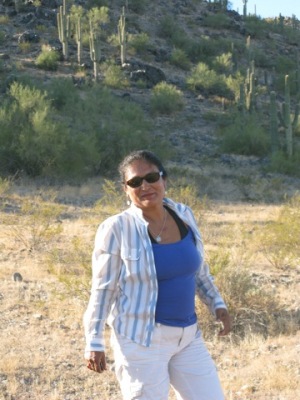 Belen at Aji Mountain“And I like your necklace,” I answered, admiring the chunky turquoise strands almost hidden by black hair cascading priestess-like down her shoulders. She was in her late forties, olive skin, dark eyes, about 5/4’, and wore a long flowered skirt. I’d been told she was a clairvoyant. “Would you like a reading?” Belen asked
One of my college professors had told me I was psychic, a gift, he said, I should develop in a positive way. I hadn’t been aware of such a talent nor did I know to tap into it. Years later, a cigar-smoking Shaman on the Amazon River told me I had special powers. I almost believed him, until he told the next person in line exactly the same thing.
Belen indicated I should sit on a stool. How would she do the reading? Animal cards? Feathers? She picked up a pen and sheet of paper, closed her eyes, and moved the pen around the paper as if in a trance, drawing squiggly circles, star shapes, and curlicues. She opened her eyes, studied the design, and said, “I have a spiritual guide named White Cloud. He directs me and sends me messages. White Cloud says you can see things other people can’t. White Cloud says we played together as children.”
I felt a small tingle. Did that mean that in a former life – if there was such a thing – I was Native American? Is that why I always rooted for the Indians and not the cowboys?
“White Cloud says you are very comfortable in the mountains,” she continued.
“I love mountains,” I said.
“My people lived in the mountains, and the spirits of my ancestors still live there.”
words + photos by Tom Adkinson
As a kid growing up in the early baby boom years, I could understand World War II because it was familiar to me. The stories were all around me.
 A friend’s father down the street had a Japanese carbine.Guadalcanal Diary was an exciting read, as was Thirty Seconds Over Tokyo. Movies such as “The Sands of Iwo Jima” and “The Longest Day” (which seemed to star every major actor in Hollywood, including John Wayne, Richard Burton and Sean Connery) filled the movie screens.
It was World War I, the one known as “The Great War,” that didn’t make much sense. It was long ago and complicated, a jumble of combatants that were difficult to sort out. It seemed to lack the drama of Midway or Normandy or the Flying Tigers.
That ended with a single museum visit in an unlikely place – Kansas City, Missouri – where I began to make sense of it all.
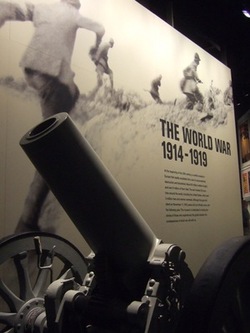
Kansas City is the home of the National World War I Museum, and the enormity and pathos of that horrible time hit me as soon as I entered.
Once inside, I stood on a glass bridge that leads to the major exhibit areas. Beneath my feet and through the glass was a field of poppies, 9,000 of them. It was an attractive and appealing art installation until I read that each of the red poppies represented 100,000 lives. More precisely, each poppy represented 100,000 deaths. That beautiful field of poppies was a statement about the nine million combat deaths of World War I.
Downtown Kansas City is a pleasant place with big office buildings, hotels, sports facilities, restaurants and the like, and the National World War I Museum is one of its landmarks.
PLANE TALK: GOT A QUESTION? ASK THE CAPTAIN!
Do you have a question about airline safety, flight etiquette, jet lag, or air travel in general? Submit your question and look for answers in a future column.
 "It feels like you can't turn on the news these days without hearing about a drunk pilot showing up for work ready to fly under the influence. Is this just media hype, or should I really be worried?" - Kathryn

I hear ya, Kathryn. "THAR she B L O W S" could be the lead-in line to the almost-monthly apprehension of professional pilots caught while flying legally drunk. But the fact remains that of the 11,000 commercial pilots tested annually, only 12 on average fail to pass. Now, that's not the zero percent we'd like to see, but it does mean that chances are good that your pilot is NOT flying drunk.
Now, for the rest of the story, which takes us to Amsterdam.
Amsterdam is known for it's tolerance and quirkiness.
Tolerance for cafe drug purchases and prostitution in it's Red Light District.
words + photos by Dr. Marissa Pei
I went to Africa expecting to have my paradigms blown out of the continent. And bombs away, my mind detonated, but in a way that was entirely unexpected.
 Dr. Marissa Pei and friend in AfricaI went to Africa thinking that I would learn to be more grateful. And I am grateful, especially for the conveniences of western civilization that I have grown accustomed to. I missed having toilets that flushed, toilet paper supplied, toilet paper that would flush, stalls where I could sit and not have to stand, and bathrooms where I didn’t have to breathe through my mouth.
Yes I am grateful for sanitization that uses up exorbitant amounts of natural resources. Would I give it up? Not in this lifetime! Will I be more grateful for American bathrooms? Absolutely! But by being appreciative for our sanitation and building codes, am I implying that we in the west are more civilized? Well if “civilized’ means beautifully-constructed and aesthetically-pleasing on the outside, yes we in the West are definitely more beautiful on the outside. But are we more beautiful on the inside?
I went to Africa thinking that I would be triggered by the haunted look in the children’s eyes, you know...like the World Vision pictures or National Geographic images…and to some extent I was. But 88 percent of the time, our eyes would meet, I would smile, and a spontaneous answering grin would break their face wide open, tapping into the reservoir of love and joy in their heart which splatters all over me.
by Bethany Ball
By my late twenties, I’d been unhappy with my body for a while. I had put on and dropped the same twenty pounds over and over again. Thin, I felt glamorous, but was in fact starving. My ideal weight was not one I could maintain. And heavy was something I was always fighting against. I needed to find a new journey to health and wellbeing.
 photo by lululemon athletica via flickr common licenseFor years I’d gone to the gym and it made me feel energized and strong. But it made my body bulky. My already naturally broad shoulders resembled those of a line backer. They’d bulked up after years of competitive swimming. My thighs were too heavy to fit in the narrow boot cut jeans, fashionable at the time. Boyfriends described me kindly as “athletic,” when I’d dreamed all my life of being lithe.
Working out made me feel powerful, but that feeling of power morphed into a feeling of being overly caffeinated. I would walk out of Crunch gym, after my regular work out, feeling twitchy and sometimes irritable. I used to call my work out my “Prozac” but, in fact, it didn’t relax me. I no longer felt powerful, I felt combative. Going to the gym made me hungry, sometimes ravenous. In college it was not unusual for me to whip up a batch of Pillsbury cinnamon rolls, eat them all, and then march over to the gym for a couple of hours. I would push my heart rate up to 110 percent, measuring it with two fingers on my wrist. I was “exerlimic” – binge eating and then exercising to the point of exhaustion.
Seeking advice, I emailed an old friend. I considered him a good source of basic wisdom, and he knew my body pretty well. I had been a photography model for him a couple of years before when I’d lived in Santa Fe, after college. Also, he wasn’t the type of guy who would brush off a very genuine comment like, “I hate my body and I don’t know what to do, since going to the gym isn’t working for me anymore.” He responded, “Why are you going to the gym all the time, anyway? Do you want to beat someone up?” He suggested I start doing yoga. “Some of the most beautiful people I know inside and out do yoga. You ought to give it a try.”
The Sierra Club hike was advertised as: Strenuous Hike along the streams and meadows of the Grass Mountain area of the Pecos Wilderness, ~10 mile one-way hike with car shuttle, possible 2000 ft. cumulative climb.